

The story of how the Buddha converted a killer is, really, the story of each of us. We all have darkness within us, whether we know it or not. And often, the harder we try to be “good”, the more we deepen our inner conflict. Today, we will look at an ancient Buddhist story that depicts this psychological trap—and points the way out of it.
What follows is my personal retelling of Aṅgulimāla Sutta, which is one of the most striking pieces of Buddhist scripture. Here, I’ll present the story through a Jungian or symbolic lens to bring out its deep insights into human psychology.
Long ago, during the time of King Pasenadi, there lived a hateful man. Brutal, with a passion for murder and destruction. He roamed the kingdom, turning villages into non-villages, reducing towns to non-towns. The people called him Aṅgulimāla, for he wore a garland (or mala) made of anguli—the fingers of his victims.
During that time, the kingdom was also home to a famed wandering ascetic, a teacher known as the Buddha, meaning “the awakened one”. One day, the Buddha was passing through a town where the people were in great distress, for the killer Aṅgulimāla had been spotted in the nearby woods. Many of the townspeople approached the great sage, concerned for his safety. Many offered him a place to stay until the danger had passed. But the Buddha, to everyone’s dismay, paid no heed to the warnings. The people last saw him leaving town and entering the woods where the killer had been spotted.
It was getting dark when Aṅgulimāla saw the Buddha approaching from afar. The killer thought to himself, “I have slaughtered whole parties of men who’ve been out to get me, and now here comes this wanderer, attacking me on his own… How proud he is! I wonder what power his fingers might hold.” Aṅgulimāla drew his blade and, concealed in deep shadow, made his way toward his prey.
The Buddha was walking at a steady pace as the killer approached him from behind. When the time to strike had come, Aṅgulimāla leapt out from the shadows and dashed toward his target. The ascetic paid no mind to him and only continued walking. Aṅgulimāla moved faster than a leopard, but run as he might, the distance between him and his target seemed only to grow. Angry and confused, the killer pushed himself even further. Like a fleeting shadow, he slid through the air, his feet barely touching the ground… But it was no use. The ascetic he was chasing kept receding in the distance.
Out of breath, his legs giving out, Aṅgulimāla gave up his chase. Never in his life had he run as fiercely as he had now, and yet his target got away. “What trickery is this?’’ he thought. “Is this wanderer some kind of a magician?”
With desperate fury, Aṅgulimāla roared out into the silent woods: “Hey, you there! Stop at once! Do you hear me? Stop!”
The next moment, the ascetic was standing right in front of Aṅgulimāla. Terrified, the killer stumbled and fell to the ground. The Buddha, wearing the moon as a halo over his head, looked Aṅgulimāla in the eyes and spoke to him in a firm, but loving voice: “I have stopped, Aṅgulimāla. Now, you stop.”
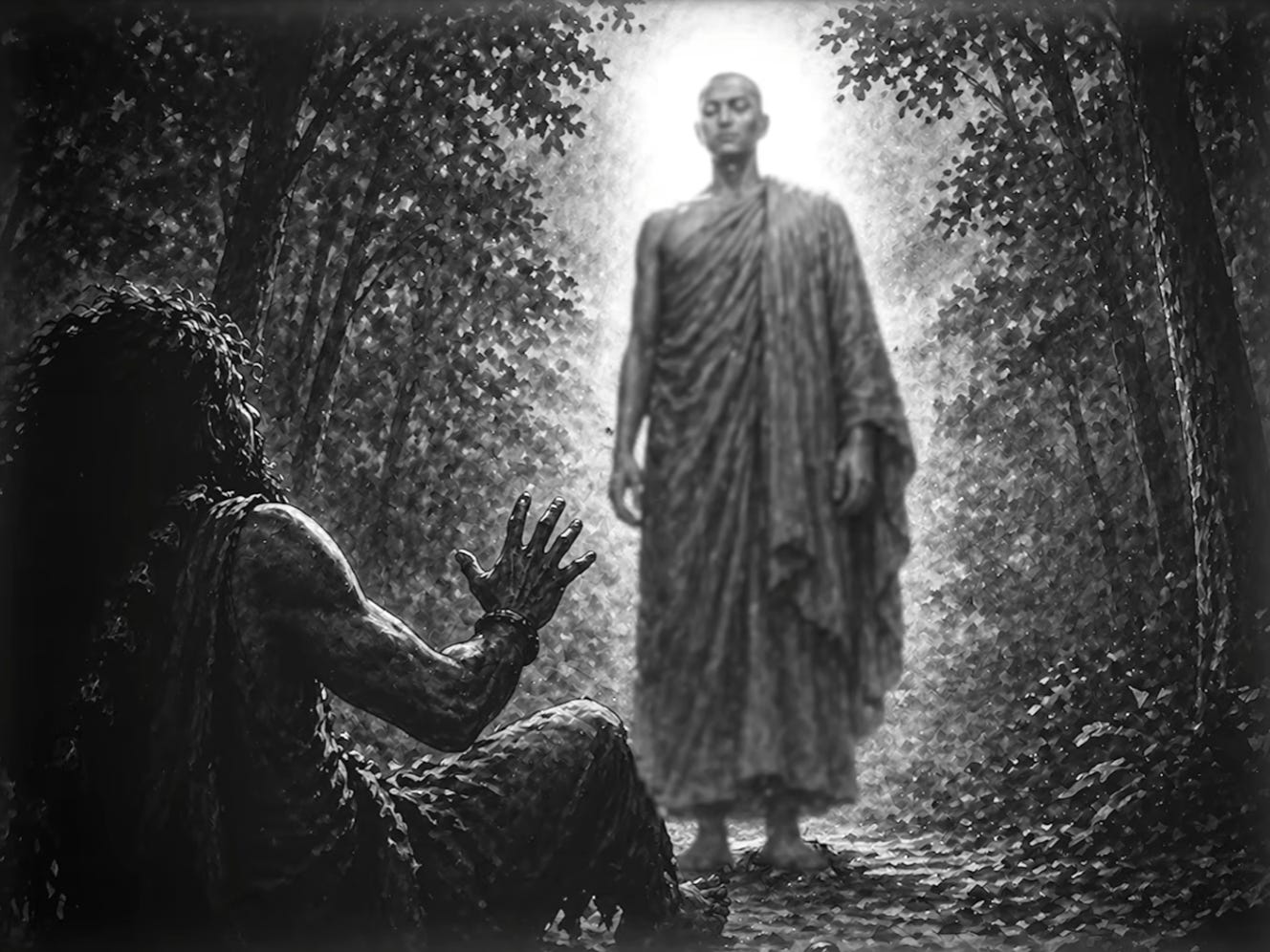
This is a good place to pause and consider what the story is saying. Notice that the moment Aṅgulimāla spots the Buddha, the killer assumes he is being attacked. He cannot conceive of another reason why somebody might approach him. If we read the scene psychologically, we might ask ourselves:
“What are those thoughts, feelings, and desires within me that feel condemned, judged, and attacked the moment they are seen?”
In depth psychology, these repressed, unwanted parts of ourselves are known as the “shadow”, and we all have them. Like the townspeople in the story, we habitually avoid facing these loathsome thoughts, feelings, and urges of ours—or we outright deny having them. But how does the Buddha treat the killer Aṅgulimāla?
“I have stopped, Aṅgulimāla,” said the Buddha. “Now, you stop.”
The killer, his face pale with terror, demanded, “What is the meaning of this? What do you want from me?”
“I have stopped once and for all,” the Buddha replied. “There is no longer any violence within me toward living beings. Now, Aṅgulimāla, you stop.”
Saying this, the ascetic offered his hand to the killer. It was an open hand, holding no blade and no shackles—a sight Aṅgulimāla had forgotten. Tears started streaking down the killer’s face. As he gazed on the radiant face before him, he realised the Buddha had not come upon him by accident or to attack him. The Buddha had come to help.
The killer took the hand that was offered and pulled himself up on his feet. He cast his weapons away in the dark and bowed, his head touching the feet of the ascetic. “Take me with you, compassionate great seer. Allow me to live with you, allow me to live as you live.”
“Come,” the Buddha replied. And so began Aṅgulimāla’s life as a monk.
Notice how the story refers to the Buddha here:
“Compassionate Great Seer”
That comes from the original sutta, not my retelling, and I think it is the heart of the message.
Only after being seen with compassion does Aṅgulimāla begin his transformation. Compassion, mind you, does not mean approval. At no point does the Buddha say, “Oh, I don’t mind you wearing human fingers around your neck; killing people is totally fine!” He does the opposite, in fact. He urges the killer to change his ways. But not as an accusation or condemnation. The Buddha extends his hand in invitation.
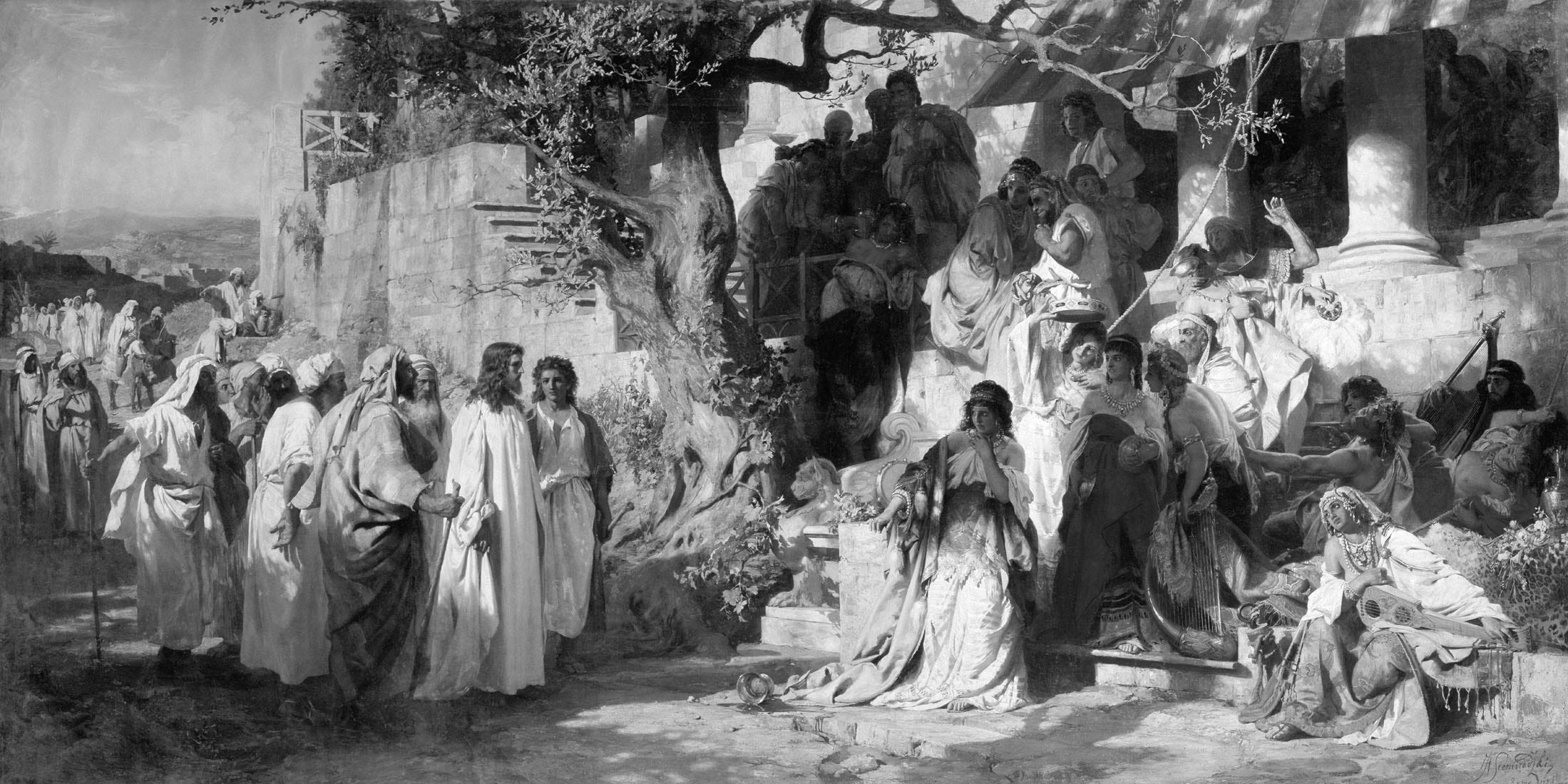
This ancient Buddhist sutta has many uncanny parallels with stories from the Gospels. Five centuries after the Buddha visited Aṅgulimāla, Christ would dine with tax collectors, prostitutes, and “sinners” of all stripes. Both He and the Buddha teach us that vice is not to be destroyed or conquered by virtue; vice must be transformed into virtue. And how does this miracle occur? Through the practice of compassionate seeing.

Now, let’s return to our story and see what more it has to teach us about inner transformation.
The Buddha spent some time wandering through the kingdom with Aṅgulimāla by his side, teaching him the life of a monk. By the time the two retreated to Anathapindika’s monastery, many had recognised the Buddha’s companion and sent word to the royal palace.
King Pasenadi, upon learning that his teacher, the Buddha, was stalked by the infamous killer, gathered a company of soldiers and set out personally with them for Anathapindika’s monastery. The king stormed into the monastery alone and headed straight to his teacher’s cell.
“What troubles you, Pasenadi?” asked the Buddha when the king entered, his hand on the hilt of his sword. “Has a rival attacked your domain? Are your people in danger?”
“My people are in danger, and so are you, teacher,” said the king with a quick bow. “A killer has infiltrated your community. This is a man I have hunted for years to no avail. He has slaughtered whole companies of my men and has laid waste to entire settlements. I fear you may be his latest target, teacher.”
“The king is in great distress,” said the Buddha to his attendant monk, “please bring some water for him.” Then, he addressed the king, “I appreciate your concern for me, and for your people, Pasenadi, but I can assure you the killer Aṅgulimāla is not here.”
“So, you know of whom I speak,” exclaimed the king. “With all due respect, teacher, I have reliable information that Aṅgulimāla has followed you on your travels, disguised as one of your own.”
“Let me ask you, Pasenadi,” said the Buddha, “what if you found that man you’ve been hunting here in the monastery, but not disguised, as you say. What if you found him clean-shaven, wearing monk’s robes, devoted to cultivating insight and compassion? What would you do then?”
“I do not believe this is possible,” replied the king, “but for your sake, I will entertain the thought. What you are asking me is what I would do in the case of a miracle. The only appropriate response then would be to bow, of course.”
“Some water for your highness,” said the attendant monk who had now returned, and he offered a jug to the king. Pasenadi took the jug and drank.
“Then bow you must,” said the Buddha to the king, “for the killer you once hunted is the monk who has now quenched your thirst.”
The king froze. Only now did his eyes rest on the monk standing before him. Only now did he notice the face, disfigured with scars. But there was no hatred in that face, there was no challenge in the monk’s downcast eyes.
A chill terror gripped the king, and his hair stood on end… But only for a moment. One glance at the Buddha was enough for him to collect himself. Pasenadi bowed to the monk before him. He then turned to the Buddha and kneeled.
“I see, teacher,” said the king, “that what I failed to achieve by force, you’ve achieved without any such means. You’ve tamed the untamable. There appears to be no need for me in this monastery, so I leave you now. The people will be relieved to hear that Aṅgulimāla, the killer, lives no more.”
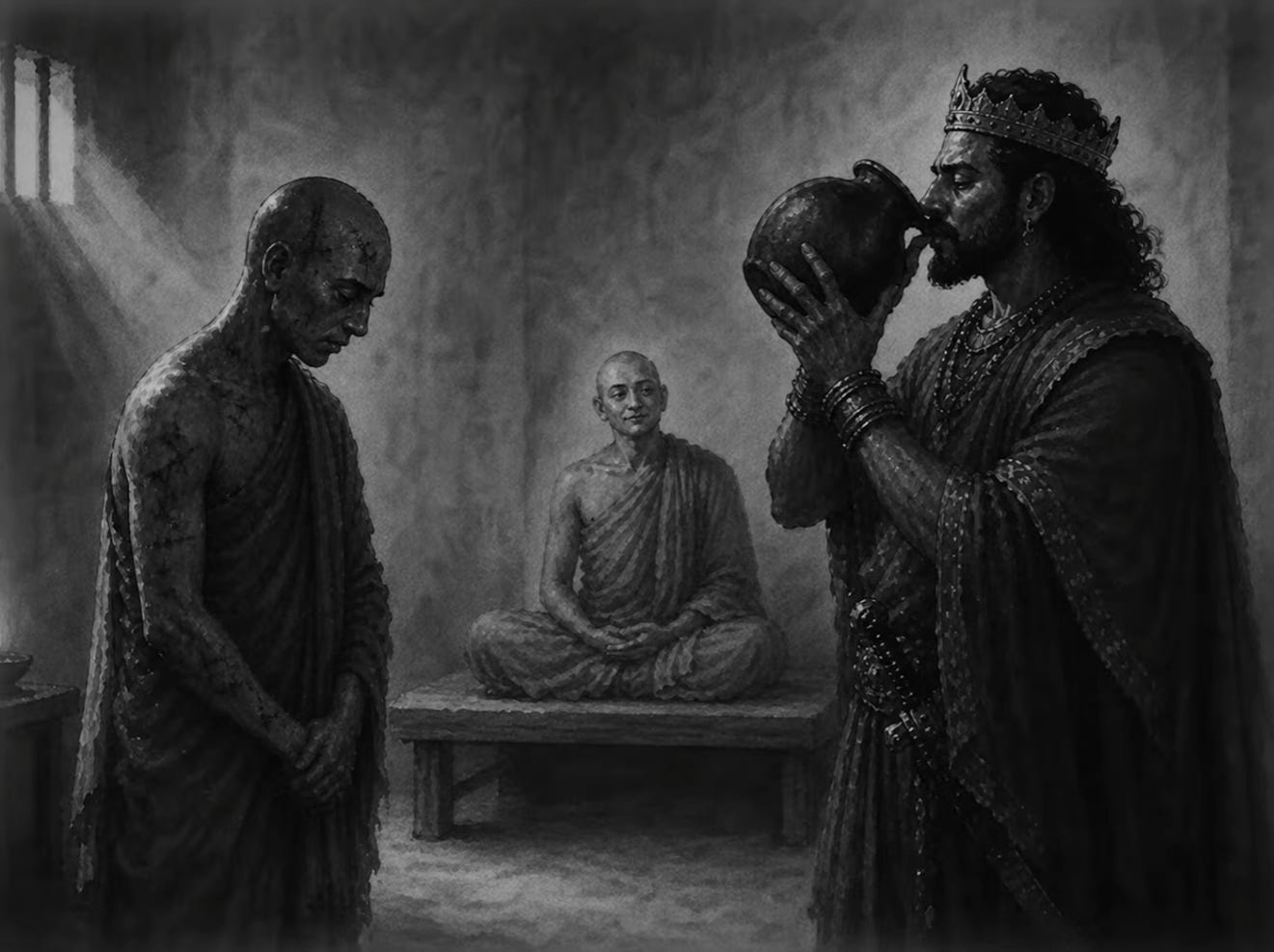
This part of Aṅgulimāla’s story reads more like a fairytale than Buddhist scripture, but it conveys profound insight nonetheless. To understand its psychological meaning, let’s apply some concepts from Jungian psychology.
Aṅgulimāla, as we saw, is a depiction of the shadow, or everything within us that we condemn. Everything we want to be rid of. King Pasenadi would then be a depiction of the ego, or our self-identity.
For most people, most of the time, the ego and the shadow are in constant conflict. For example, when I say, “I am a good person,” I identify with all my impulses to help others. These become part of my self-identity, part of my ego. But then, what happens to my anger, my envy, my hatred? Well, I deny having such feelings, so they get pushed away from the ego and become shadow. As a result, the more I seek to be good (or to see myself as good), the more divided I become.
When King Pasenadi describes how he’s been hunting Aṅgulimāla to no avail, this is a figurative description of our internal dynamics, the way the ego is constantly chasing its own shadow. But then the king discovers the killer transformed into a monk; the shadow has become light. The psychological equivalent of this is to see our vices turn out to be virtues, to see the worst within us turn into a force for good. You may wonder whether this is possible, and the king shares your disbelief. But the Buddha insists: “the killer you once hunted is the monk who has now quenched your thirst”. If the story claims such an inner transformation is possible, then how can we achieve it in our own lives?
The story is actually clear that we—meaning, our egos—cannot make it happen. The king tried everything, but never managed to catch Aṅgulimāla. Indeed, one of the core insights of depth psychology is that the ego’s efforts to overcome the shadow only feed the shadow further. Remember, the shadow is made of our attempts to get rid of certain aspects of ourselves. If we try to get rid of the shadow, we only give it more of what it is made of! For example, if we have anger issues, one sure strategy to perpetuate the problem is to keep telling ourselves, “I shouldn’t be angry!”
So, what can we do? Since the way of the king doesn’t work, we may try the way of the Buddha. How does the Buddha, using no force or deception, manage to convert a killer into a saint? Let’s examine the chain of events.
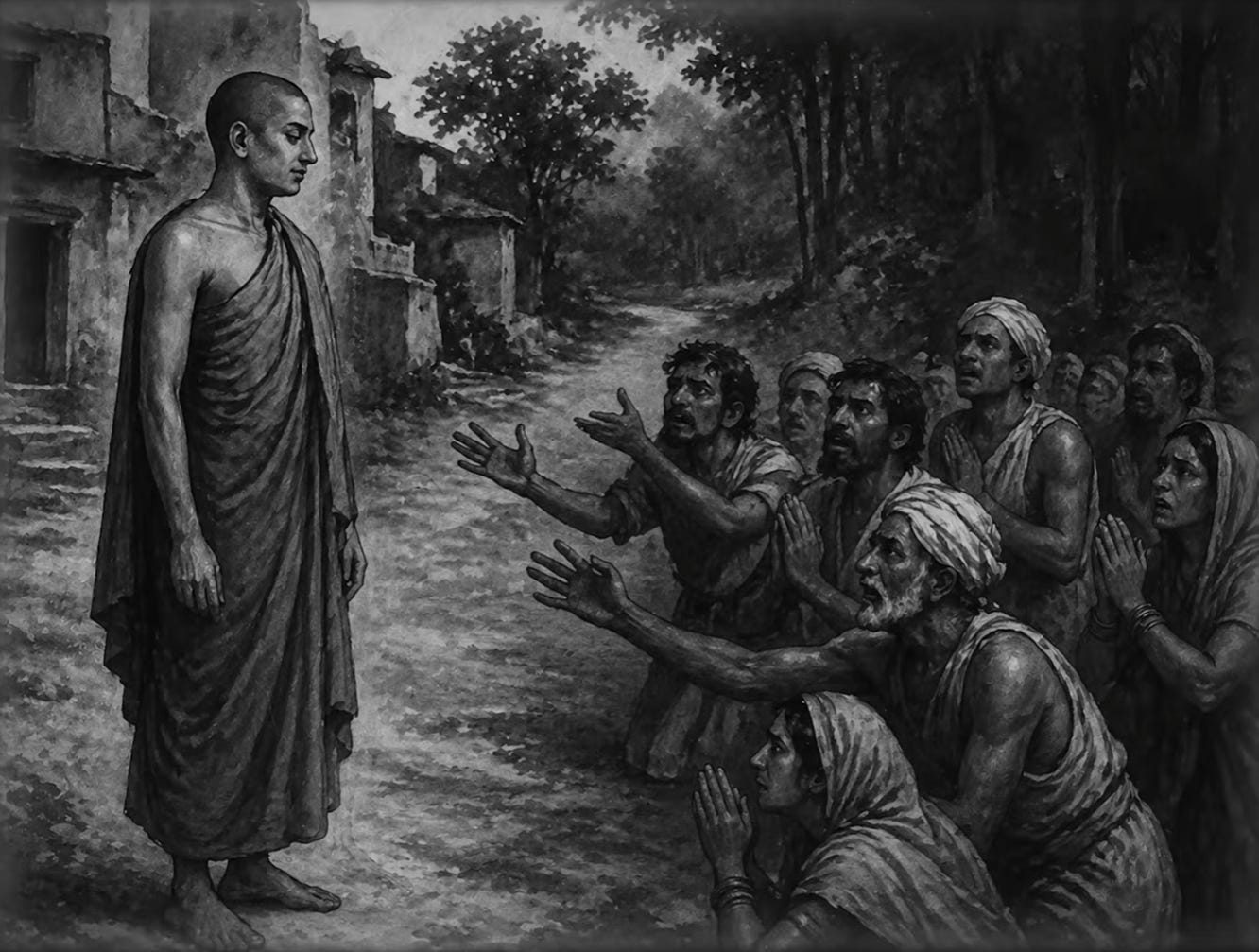
First, all the townspeople warn the Buddha not to enter the woods where Aṅgulimāla is hiding. What is the psychological significance of this?
We all have a tendency to avoid facing certain aspects of ourselves. We often prefer to explain away certain feelings, thoughts, or actions of ours, or to pretend like they are not there. This, of course, prevents us from engaging with exactly those aspects of our personality we most need to work on. If the Buddha had listened to the people, he would never have converted Aṅgulimāla, and the killer would have gone on to claim many more victims.
Next, we learn that the Buddha enters the forest unarmed, though he is aware of the danger lurking there. He goes to the killer as a “compassionate great seer”. To follow the Buddha’s example would mean to intentionally seek out everything within us that we find difficult to accept. But—and here is the key point—we must approach this difficult material not as adversaries, but as compassionate seers.
Shadow integration is subtle and often counterintuitive work. We learn that trying to get rid of the shadow is actually what sustains it. But then, if we try not to want to get rid of it in order to get rid of it, this is only a subtler form of the same issue, and the shadow persists.
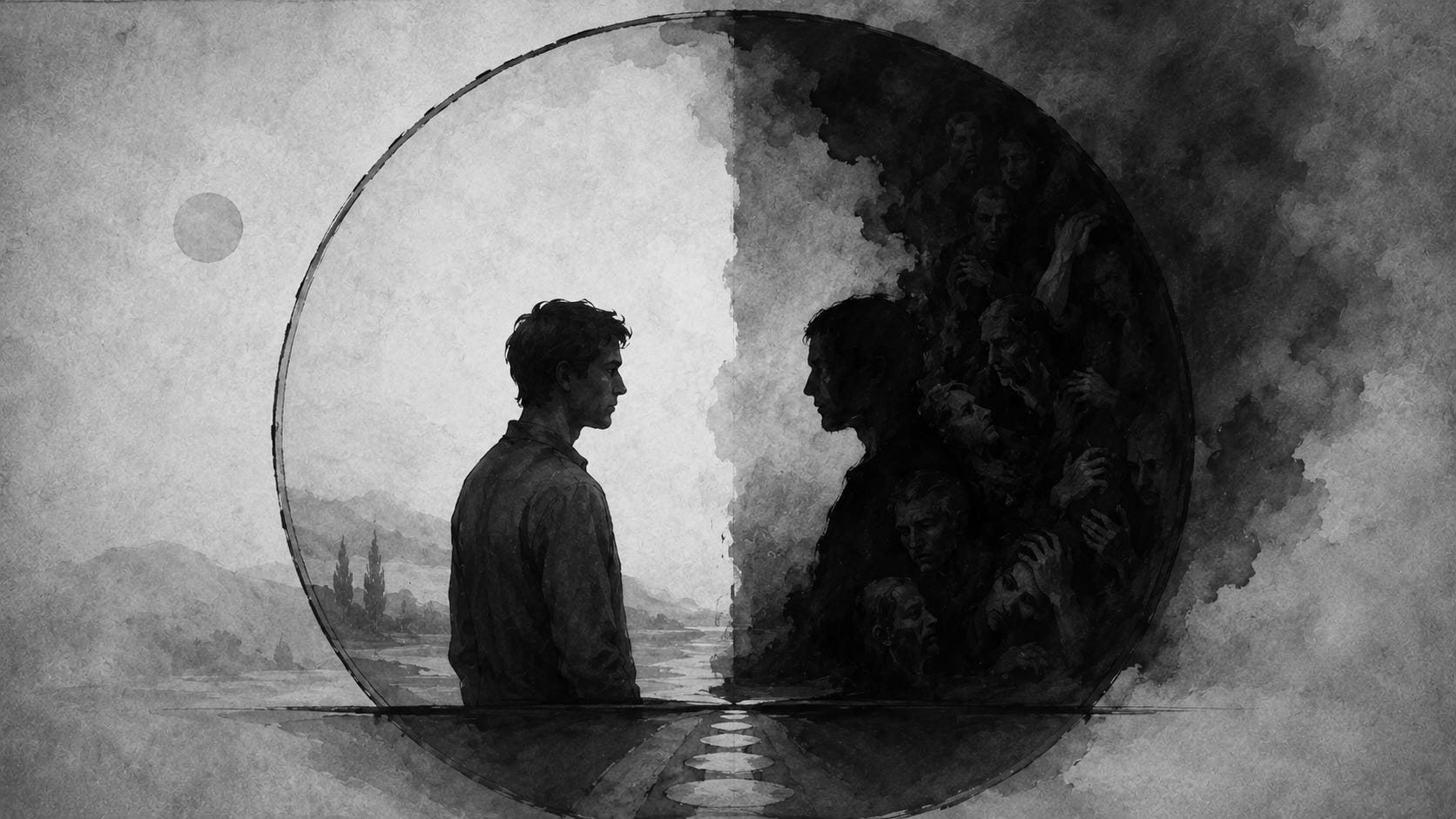
The way to cut this Gordian knot is to accept that we really cannot destroy or fix, or transform the shadow—but we can allow it to transform itself. How? By giving it the one thing we’ve been depriving it of: compassionate seeing.
Only once we invite our darkness into the light of compassionate awareness can it begin to heal. In the story, remember, it was Aṅgulimāla who pleaded with the Buddha to accept him as a monk. All the Buddha did was visit Aṅgulimāla and offer him a hand, not approving his crimes, but not condemning him for them either.
Shadow integration is more of an art than a science. It is not a matter of mechanically following a formula like “observe your vices, don’t judge them, and they’ll change”. If we are using a formula, strategy, or technique, we are already approaching our shadow with condemnation, which only deepens our inner conflict. To heal the shadow requires a fundamental change in our attitude, a different way of living, really. It is something you can’t fake or achieve by following a prescribed formula. For the shadow to change, the ego must change. It must grow humble, like the king bowing to the Buddha, and accept that its condemnation may be the very root of the problem. Only then does the miracle occur.
Once our vices are truly seen with compassion, they begin to mature into virtues. Anger develops into the ability to stand up for oneself. Envy settles into the skill of admiring others and learning from them. Hatred resolves into acceptance of the true complexity of others and of oneself.
Integrating our shadow may seem like strictly personal work, but it actually improves our relationships with others as well. As the fractured parts of our psyche reunite, we learn to accept both ourselves and others whole, not just the parts we find pleasant. Ironically, the more we let go of our “good” self-image, the more peaceful and understanding we become. No wonder Jung exclaimed:
I would rather be whole than good.
–C.G. Jung (attributed)
The encounter between the Buddha and Aṅgulimāla depicts the psychological drama of each of us. Making peace with our shadow is one of the most important initiations of human life, and yet many never undertake this task consciously. Many of us live our lives split in two, caught in an endless civil war between what we accept and what we don’t accept within ourselves.
If this piece resonated with you, one of my previous essays goes deeper into the practical side of shadow integration, according to Jung’s experience and insights. I invite you to read that next, if you want to learn more.
Thank you for reading, and remember, “What you seek is seeking you”.
How To Integrate Your Shadow
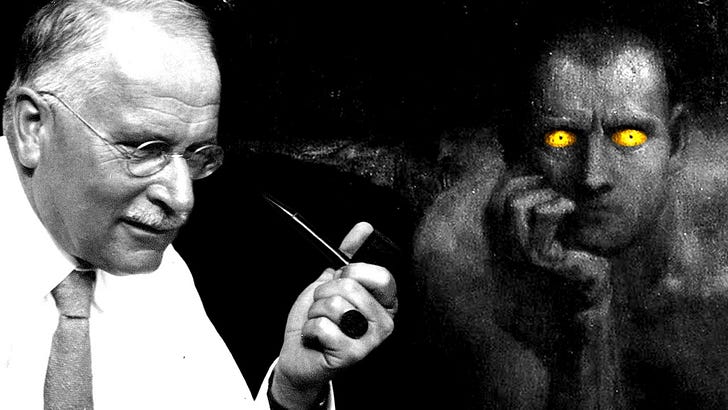
Each of us is a battleground where light and darkness meet. But these two forces, so opposed, come from the same womb. They are siblings who either thrive together or perish in mutual destruction. The quality and depth of our lives hang on our ability to bring peace to the battleground and unite what has been torn apart: ourselves.
Superb, as I've come to trust your essays' tendency to be. Thanks, Simeon, for your characteristic clarity and candour. This compassionate, gentle 'mentoring' of one's own shadow elements seems to be a deep soul-level befriending, all right -- and (for me and most, I think) a lifelong calling.
FYI, here's a nutshell version of a fine parallel tale from North America's First Nations: I often used it in teaching my college students' course in World Myths. (I Love it!) *
*1-minute read!
-- "The foundational oral traditions of the Haudenosaunee (Iroquois) First Nations include this story of Deganawida, The Great Peacemaker. According to the legend, Deganawida crossed Lake Ontario in a canoe made of white stone as a sign of his power.
He sought out a notorious murderer and cannibal among the Onondaga people to test his message of peace. [1, 2] Finding the man’s cabin empty, Deganawida climbed onto the bark roof and peered down through the smoke hole. Below him, a pot of water boiled with human remains.
When the cannibal returned and looked into the pot, he didn’t see the human flesh. Instead, he saw the reflected face of Deganawida looking up at him from the water. Mistaking it for his own reflection, the warrior was struck by the contrast between his monstrous actions and the strong, noble face staring back at him.
Filled with intense shame and revulsion, he poured the contents of the kettle out and sat brooding by the fire. [1] When Deganawida at last entered the cabin, he offered the warrior the Good Mind - a message of peace, reason, and brotherhood. The man repented, giving up his cannibalistic ways. Together with Hiawatha, both Deganawida and the former cannibal traveled to the other warring nations to plant the Tree of Peace and establish the Great Law. [, 2, 3]
Rather than using violence, Deganawida ended the cannibal's reign of terror by healing his mind using profound reflection and the Ceremony of Condolence. [1, 2, 3, 4] The Reflection of a New Mind & The Message of Peace."
Hi Simeon,
I thoroughly enjoy your beautiful letters. Thank you for your work.