


Most of us cannot explain the grammar of the languages we speak. This doesn’t keep us from using that grammar almost perfectly in the most sophisticated ways every day. The structure of language is invisible to us precisely because it underlies our thought patterns, not despite it. We can think about grammar analytically, but we are fluent in a language only to the degree that we don’t have to think about it when we speak it. Language ceases to be an object and is experienced as part of the subject.
The same principle applies to other unconscious contents. We are “fluent” in our traumas, our projections, and our defense mechanisms only when we are unaware of them. With our rational, conscious minds, we may wonder why we seem to make the same mistakes over and over again, while the unconscious “grammar” of our psyche dictates our every thought, word, and action. As Jung is quoted as saying: “Until you make the unconscious conscious, it will direct your life and you will call it fate.”
Most of all, we are “fluent” in our self-identity, the first and last concern of our conscious lives. As Yogācāra Buddhists pointed out centuries ago, a mental stream identifies as a self precisely to the degree that it is ignorant of the fact it is doing so. A deep enough glimpse into how the mind constructs the self can break the spell, and the mental stream wakes up from the dream of being you. Free of language, the mind can rest in silent and unutterable “thusness”.
May thought terminate in understanding,
Simeon
“A thought comes when ‘it’ wishes, and not when ‘I’ wish.”
—Friedrich Nietzsche, Beyond Good and Evil
Suggested Reading

I Am a Strange Loop by Douglas R. Hofstadter
Where does the felt sense of “I” actually come from? Douglas Hofstadter proposes that a self is not a substance but a pattern, a loop of symbols folding back on themselves until an “I” seems to appear, real enough to grieve and love and mistake for solid ground. Los Angeles Times Book Prize Winner, 2007.
Order here to support SEEKER TO SEEKER at no extra cost. You can also browse my personal list of favourite books here.
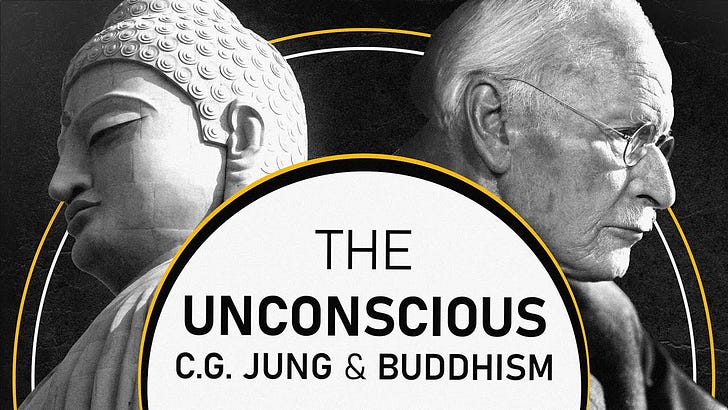
Carl Jung & Buddhism On The Unconscious
"Everything of which I know, but of which I am not at the moment thinking;… everything perceived by my senses, but not noted by my conscious mind; everything which, involuntarily and without paying attention to it, I feel, think, remember, want to do; all the future things that are taking shape in me and will sometime come to consciousness; all this is the content of the unconscious."
C.G. Jung, On the Nature of the Psyche
Thank you, Simeon. I find your teachings of the Buddha and all the masters of mind beautiful and always inspiring. I listen to and watch them over and over again. So clear!