

Why are we never content? Whatever we come to possess, experience, or achieve, it only brings us fleeting satisfaction and then leaves us with a hunger for more. Is it even possible to find peace and happiness that last?
Over two millennia ago, the Buddha confronted these same questions, and this led him to one of his deepest (and most counterintuitive) insights: that the very thing we’re all doing to find happiness is what keeps it from us.
A Gnawing Feeling
Anxiety, regret, disappointment, the gnawing feeling that something about our life is not quite as good as it can be... We humans have always had reasons to be dissatisfied, but probably never as many as we have today. We are, after all, living in the age of “endless opportunity”, which also means endless missed opportunities.
For every choice we’ve made, we know there are a million others we could’ve made that might just have turned out better. The fact that no achievement, experience, or possession grants us lasting contentment seems to confirm our suspicion. As does social media, constantly feeding us airbrushed images of perfect lives and ads for the next purchase that will solve all of our problems. We thus keep one another on the hamster wheel, never arriving at the life we are craving, but ever departing from the life we are actually living here and now.
This restless searching and discontent is not a modern malaise. Millennia ago, the Buddha diagnosed it as the universal affliction of human beings. In Pāli, the language of early Buddhism, it is called dukkha.

Dukkha is a notoriously difficult word to translate. It covers a whole range of meanings: “dissatisfaction”, “stress”, and “suffering” are different shades of it. But by dukkha, the Buddha does not mean any particular experience; he means the fact that every experience, sooner or later, brings us discontent.
Painful experiences bring discontent because, well, we would rather not feel pain. Pleasurable experiences bring discontent because they never last and only leave us wanting more. Even neutral experiences bring discontent, as their unstable coming and going keep us always on our toes, chasing fleeting peace and satisfaction in an unpredictable world.
This teaching can seem like a bleak view on life, like a form of pessimism or nihilism. But if we consider “the teaching within the teaching”, as it were, we actually find the key to that peace and happiness we are all craving.
The Teaching Within the Teaching
Think for a moment what it would mean to live as if nothing can bring you contentment. What would it be like to live your life exactly as you are already living it, with the only difference that you do not seek happiness in any achievement, possession, or experiences of whatever kind?
It’s easy to confuse the Buddha’s teaching with New Age slogans such as “peace comes from within” or the like. Owning a Porsche might not be the key to happiness, but then maybe a meditation retreat will do the job, or some life-changing psychedelic experience?
You see, the Buddha’s teaching goes deeper than merely internalising our quest for contentment. In the original suttas, he does recognize the bliss of deep meditation as superior to sensual pleasure. But even such transcendent experiences, the Buddha says, bring discontent. Why? For the simple reason that they never last.
It is irrelevant what we are pursuing in our quest for happiness, the Buddha says, be it a material or a spiritual thing. Our mistake is not that we are trying to get contentment from the wrong things. Our mistake is that we are trying to get contentment.
We are like a man looking for his sight. He will wear himself out searching the whole world and never once even glimpse it. If some well-intentioned guru tells him to look for his sight within, the man will only get more confused.


The heart of the Buddha’s message is that the very search for contentment is bringing us discontent. The search itself creates the lack it is trying to rectify. And the Buddha did not just talk about this; he exemplified it in his life.
Think of all the things you derive pleasure, joy, or satisfaction from in your life. These may include your relationships, your work, your home, money, sex, food, etc. Now imagine losing each and every one of these things. Imagine living penniless, stripped of all social status, owning only one set of clothes, living on whatever food strangers have to spare, and avoiding all sensual pleasures.
For most (if not all) of us, the above is a worst-case scenario. It is a life deprived of all our familiar sources of pleasure and comfort. But that’s exactly the kind of life the Buddha chose for himself and his most devoted followers! In the early suttas, we read:
Just as a bird, wherever it goes, flies with its wings as its only burden; so too is [the monk] content with a set of robes to provide for his body and almsfood to provide for his hunger. Wherever he goes, he takes only his barest necessities along. This is how a monk is content.
Samaññaphala Sutta; DN 2
For the Buddha, monastic life is not about deprivation or punishing ascetic practices. It is a life devoted to freedom. And a happy life.
It is staggering that most people’s worst-case scenario is actually the kind of life the Buddha embraced as most conducive to contentment. And we know as a historical fact that the richest and most powerful people of his time would visit his cell to seek guidance on how to live happier lives. Even just thinking about this can release some of our anxiety about not achieving or owning the right things. You don’t need more than a set of clothes and some food to be happy, the Buddha says… And in fact, he goes further. You don’t need anything at all.
Peace that Passeth Understanding
Let’s briefly look at nirvāṇa, or nibbāna in Pāli. Nibbāna is famously known as the goal of Buddhism, the end of all discontent. But the popular understanding of it as some great achievement, event, or experience is not what the Buddha had in mind. Here is how he speaks about nibbāna:
There is, monks, an unborn — unbecome — unmade — unfabricated [...] precisely because [that exists], escape from the born — become — made — fabricated is possible.
Nibbāna Sutta; Ud 8.3
I know this may sound way too mystical and abstract at first, but allow me to elaborate. The Buddha is making one of his most important points here.
Nibbāna is essentially what we are all craving: complete peace and happiness. Now, what could the Buddha mean by calling this “unborn” and “unfabricated”?
In our everyday language, the Buddha means that true peace and happiness cannot be produced, gained, or achieved. The things we produce, gain, or achieve—whether a Porsche or spiritual ecstasy—these come and go. And no matter how pleasurable or profound they feel, they always leave us with the aftertaste of discontent and further craving. Nibbāna is contentment that neither comes nor goes, but always is.

I understand this may seem removed from our everyday experience, but it is not only monks and scholars who can benefit from the Buddha’s deeper teachings. Living as a monk, practicing meditation, and studying the suttas can greatly help one realize nibbāna, but they are not necessary for it. And that’s the whole point. Nothing is necessary for nibbāna.
There is nothing you need to do, no place you need to visit, no experience you need to have, no item, knowledge, or teacher you need to be content. The reason why the Buddha recommends letting go of attachments is not that deprivation produces happiness. Nothing produces true happiness, as he clarifies; nibbāna is unfabricated. Rather, as we learn to no longer seek contentment through external or internal sources, we begin to recognize the unborn, ever-present contentment inherent in being. We don’t achieve nibbāna—we realize it.
I don’t think the only way to embody this insight is to retreat from the world and become a monk or a nun. I think we can realistically retain most of our interests, goals, plans, and activities, with the only difference that we are no longer milking them for fleeting pleasure or some imagined satisfaction. We can continue doing what is necessary and what brings us joy, only we no longer burden it with the expectation that it will sate our thirst for peace and happiness. We recognize nothing will sate that thirst, as the only reason this thirst exists is that we’re failing to recognize that which is already and always present.
Of course, discovering the truth of this insight is not as simple as reading this essay or a few suttas. An intellectual conclusion lacks the power to truly change our deeper patterns of thinking and behaviour. The Buddha knew this, and that is why he was not a philosopher. He acted more as a physician, and he prescribed a holistic approach to liberation, with guidance on the way we speak, act, work, meditate, and more. He called this approach the Noble Eightfold Path, and it is his practical guide to nibbāna.
So here is the paradox of the matter. There is nothing we need to do to be happy, but there are all these ways in which we are keeping ourselves unhappy that we need to relinquish. Even though nibbāna is not some distant destination, there is a path that leads to it. That path, however, does not consist of accumulating, but of releasing, not of making something happen, but of recognizing that which already is.
I invite you to read my essay on the Buddha’s Noble Eightfold Path next, where we explore it with the help of one of the most powerful suttas. As always, thank you for reading, and remember: What you seek is seeking you. See you next time.
Buddha's Guide to Enlightenment
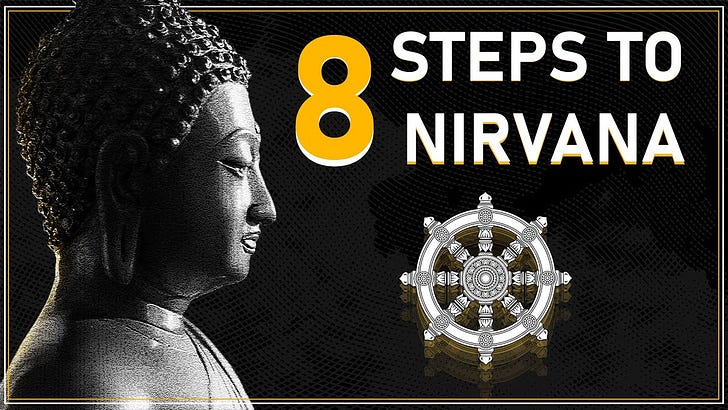
The Noble Eightfold Path of Buddhism is, simply put, the path to nirvāṇa. It is the teaching put into practice. To walk this path all the way is to reach awakening and liberation.
Thank you for your insights! Over the years, I have benefited greatly from your writings. I have a curious feeling—as a Chinese native, I can easily read and recite Zen classics in the original. Yet somehow, after years of extensive reading, the experiences that have brought me the most pronounced 'sudden awakening' have often come from English-language content, such as your articles and Alan Watts's lectures. I suspect this may be due to the stronger logical structure of the English language, as well as your and Watts's remarkable ability to synthesize and integrate ideas.
The central theme of this essay, in my view, resonates deeply with the Zen perspective—and Zen, in turn, adopts a stance that transcends the doctrinal divisions between Theravāda and Mahāyāna.
I understand it was not in Buddha's scope to explain rationally but to prescribe a way to liberation. However in our age, one more explanation that would have been meaningless before the process of evolution was formulated, could be of some help to the overly rational mind. During the course of evolution, the need for a better form (medium) of experience, in order to get a fuller degree of consciousness, was the driving force for the emergence of forms that could offer a more complete experience of the world. But no matter how evolved the form that emerged was, the experience was always limited and unsatisfactory. The Original Infinite and Unbounded 'unborn' state of Being, could not find its desired expression during all the long process of evolution. But when the human form emerged, it could reach the state of the Buddha with no further evolutionary need. Yet what remained in the first humans and still remains, is the feeling of never finding the desired fulfilment in consciousness, i.e. the state of Nirvana ( the original unborn state of Being). So the only way to get there is to become the Buddha, and no one but the Buddha can reveal this to others and create a path for them to get there.