

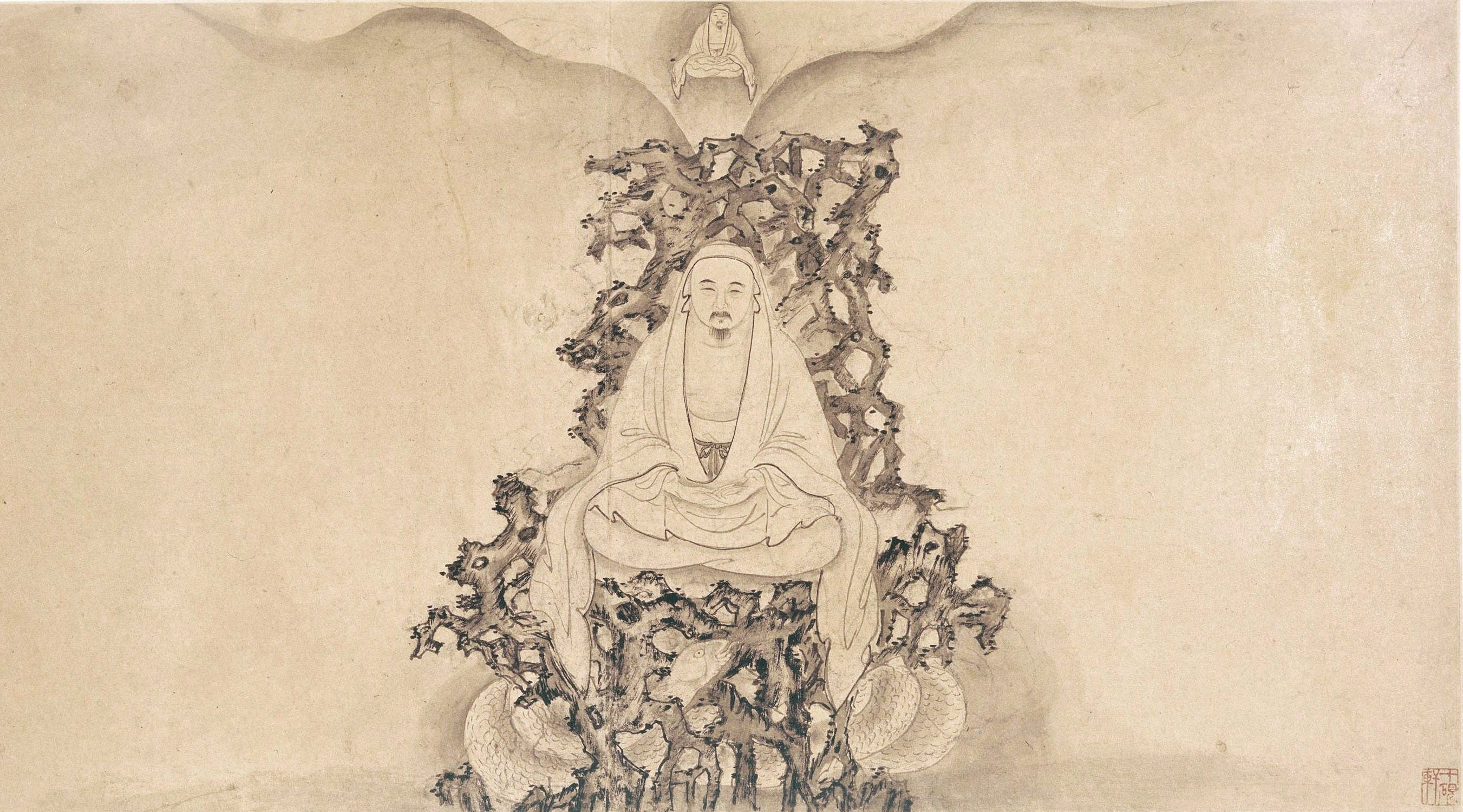
Meditation, as I understand it, is the practice of uncovering awareness by letting go. But even meditation can become an object of attachment. “How should I do it? For how long? And what if I miss a day?” Such worries turn the practice into yet another enterprise to occupy the mind with a profusion of thoughts, fears, and desires, which only obscure awareness.
In an effort to let go of vain ambition disguised as spiritual discipline, we may drop formal meditation altogether. Instead, we may seek to imbue our everyday activities with mindfulness. We thus attempt to “meditate on the go”, to observe the mind in the midst of action. For most of us, this is not a sufficient replacement of formal practice. We live in a fast-paced, craving-fed world where our attention is constantly preyed on from all sides. It is not impossible to go through the day with presence of mind, but I wouldn’t bet on it. Sitting silently for a few minutes during the day is vital in reminding us that the peace and completeness we seek outside is inherent within us.
I would suggest a third way to approach meditation—a “Middle Way”, to echo Buddhist terminology—which can retain the benefits of the practice without developing attachment and anxiety around it. Instead of treating meditation as some special, “spiritual” activity, we may see it as something similar to taking a shower.
Most of us shower more or less consistently without making a big deal of it. To shower is technically not necessary, but it is good for us. Just as importantly, it feels good in a wholesome way. There are many benefits to it—physical, psychological, and social—but we don’t do it with some distant goal in mind. We don’t feel like less of a person if we occasionally skip our usual shower, since we are not deriving our sense of self from it. Taking a shower is both a core part of our lives and nothing special.
To approach meditation in the same way (as a “mind-shower”, if you will) is a good way to relax our relationship with it. Our practice ceases to be a spiritual chore, a permission to feel enlightened (or getting there), or an activity burdened with fantastical expectations. To thus bring meditation down from its transcendent pedestal to the level of the ordinary doesn’t lessen our practice, but actually deepens it. One may argue that we haven’t even started meditating before we’ve let go of our ideas about what meditation is.
Shikantaza (只管打坐) is how Sōtō Zen refers to the practice, which means “just sitting”. Once we relax into this attitude free of attachment, free of expectation, free even of the idea of a “practice”—then, simple experiences such as water streaming down our skin or being aware of being aware reveal themselves as anything but ordinary.
May we meditate meditation away,
Simeon
The reason we suffer is that we seek peace elsewhere, and do not experience that we are peace incarnate itself.
—H. W. L. Poonja
Suggested Reading

How To Meditate Without Even Trying by Peter Russell
I recently read Peter’s new book and spoke with him about in on the podcast (the episode will come out in about a week’s time). At a time when I had complicated my relationship with meditation unnecessarily, his book was a good reminder of the fundamentals of the practice—and of it’s profound value. Whether you are a seasoned practitioners or just starting your meditation journey, I think you’ll find much insight and inspiration in Peter’s book.
Order here to support SEEKER TO SEEKER at no extra cost. You can also browse my personal list of favourite books here.
In our previous conversation, physicist-turned-mystic Peter Russell joins me to explore why consciousness may be more fundamental than matter, touching on Maharishi and TM, non-duality, science vs. spirituality, time and eternity, and what kindness asks of us.
Dear Simeon, the shower example is very good and maybe includes what I will say. I have lived both in noisy cities and in very remote countryside. Taking a walk for me has no parallel. In the cities I always look for parks of course. Somehow trees and plants and birds produce a very meditative background. I can of course carry the noise of life or my irrelevant thoughts with me, but past that, I find walking as close to, or within, nature a perfect catalyst for meditation. I used to do what Meher Baba called "dissociative meditation" but then I didn't even need it after a certain point. I can more readily lose my limited self when walking. Thoughts do come, but they are seen as the rest of the landscape, passing by. I just wanted to add this in case it helps as a consideration.
Thanks for this! This is exactly what we do at Sitting Lab, resting in a felt sense of embodied open awareness. But we do it together, which makes a huge difference. Keep the nice articles coming Simeon!
https://www.sittinglab.com