

Carl Jung dedicated his life to understanding the human psyche—and his own. Borrowing Nietzsche’s incendiary phrase, “Become yourself!”, he developed his vision of “individuation” (or uncovering one’s unique potential and stance on life) as the ultimate purpose of human existence.
But despite all his self-inquiry, self-knowledge, and self-development (or perhaps because of them), Jung shares some striking non-dual experiences in his late years. In his autobiography, written in his old age, we read:
“At times I feel as if I am spread out over the landscape and inside things, and am myself living in every tree, in the plashing of the waves, in the clouds and the animals that come and go, in the procession of the seasons…”
— C.G. Jung and Aniela Jaffé, Memories, Dreams, Reflections
We may wonder whether Jung is not contradicting his earlier preoccupation with “becoming oneself” here… Or whether, on the contrary, he is describing an advanced stage of self-awareness. In his personal letters, he reveals even more:
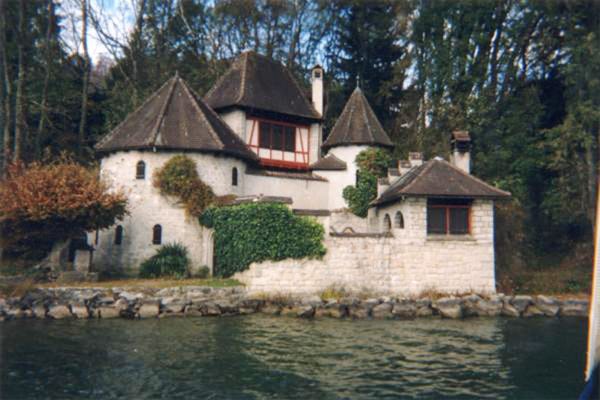
“I observe myself in the stillness of Bollingen and with all my experience of nearly eight decades must admit that I have found no rounded answer to myself. I am just as much in doubt about myself as before, the more so the more I try to say something definite. It is as though familiarity with oneself alienated one from oneself still further.”
— Carl Jung, Letters Vol. II
The Buddha, I think, would be happy to hear Jung’s ultimate conclusion about himself… That is, his lack of any conclusion whatsoever.
In Ānandasutta (SN 44.10), the Buddha is silent when asked whether the self exists; he is then asked whether the self does not exist, and he remains silent. Could there be more freedom in that silence than any conclusion could convey?
May we grow familiar with ourselves,
Simeon
“If the soul is to know God, it must forget itself and lose itself; for as long as it contemplates self, it cannot contemplate God.”
— Meister Eckhart
Suggested Reading

Aion: Researches into the Phenomenology of the Self by C.G. Jung
“Aion, originally published in German in 1951, is one of the major works of Jung’s later years. The central theme of the volume is the symbolic representation of the psychic totality through the concept of the Self, whose traditional historical equivalent is the figure of Christ. Jung demonstrates his thesis by an investigation of the Allegoria Christi, especially the fish symbol, but also of Gnostic and alchemical symbolism, which he treats as phenomena of cultural assimilation. The first three chapters—on the ego, the shadow, and the anima and animus—provide a valuable summation of these key concepts in Jung’s system of psychology.”
Order here to support SEEKER TO SEEKER at no extra cost. You can also browse my personal list of favourite books here.
Carl Jung vs the Buddha: Self or No-Self?
The Self is the central archetype of Jungian psychology. For Jung, it is the organizing principle, the process, and the goal of psychic growth. The non-self is the core Buddhist teaching. For the Buddha, insight into non-self is the organizing principle, the process, and the goal of spiritual growth. So, are Buddhism and Jungian psychology at odds? Must you reject the one if you are to embrace the other?
Thanks for the seeking spirit of this musing, Simeon. It has rather merry resonance for me here at age 81, grateful to be at ease with little remaining 'identity' stuff in the usual sense. Reminds me of that classic Zen tale of Bodhidharma when Emperor Wu challenged him to identify himself. Lovely and affirming to see Jung's affinity with 'emptiness' in the snippets you share.