

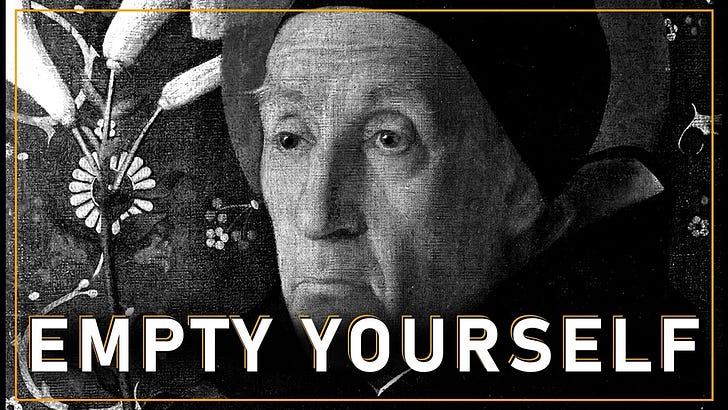
“We are all meant to be mothers of God...for God is always needing to be born.”
― Meister Eckhart
What is the true purpose of human life? In this world where nothing but hardship is guaranteed, is there something really worth striving for, something worth staking your life on?
When Jesus of Nazareth delivered his message, the “Good News”, he offered a profound answer to these questions. He delivered this answer in the form of parables. This spoke directly to the people, but also veiled his words in mystery. So much so that he has been misunderstood, misrepresented, mistranslated even, to this day.
Here, we will look at Jesus’ parables through the lens of depth psychologist Carl Gustav Jung. Without reducing Jesus’ teachings to psychology, we will nevertheless look at their psychological significance. That is, what they tell us about our inner life as individuals. As you’ll see, this will reveal a whole new dimension of Jesus’ message to the world.
We begin our journey at the end. The place Jesus points to again and again…
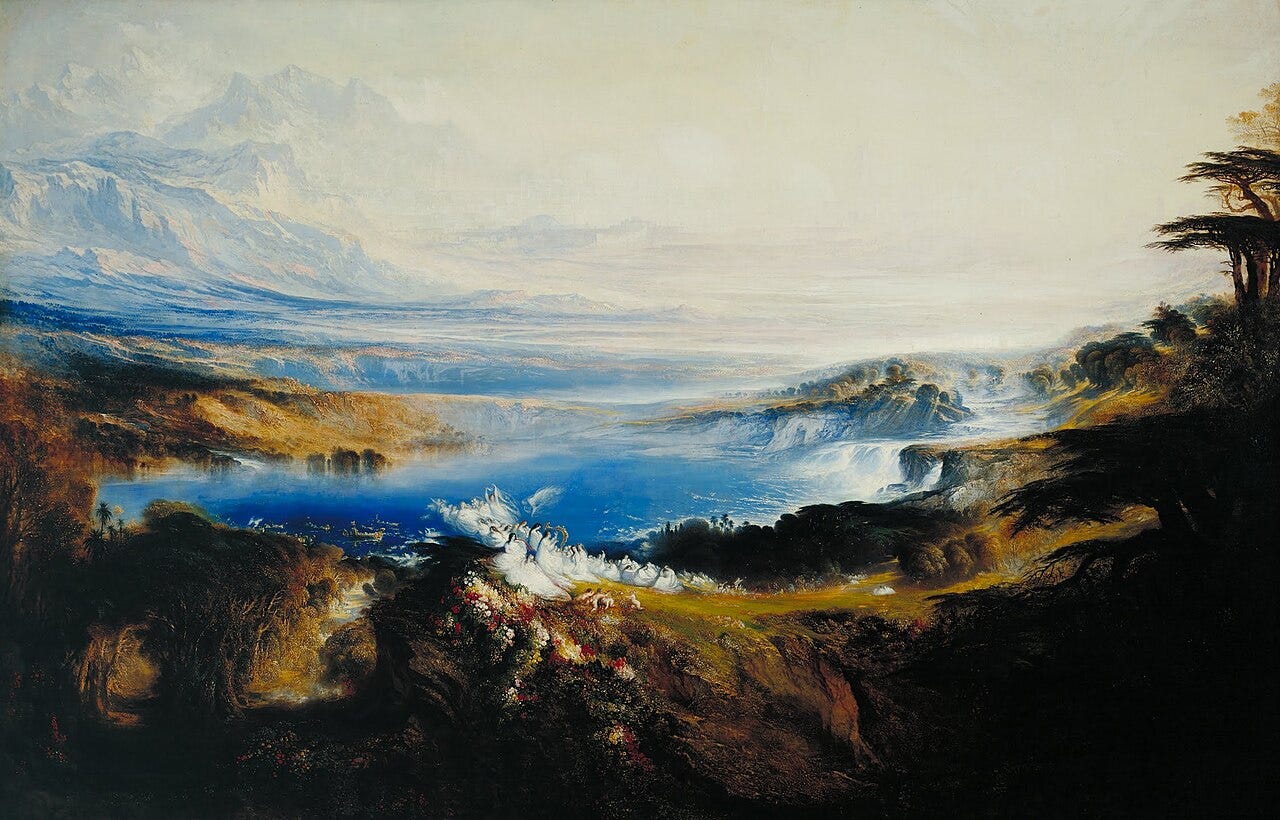
I. THE KINGDOM
In the Gospel of Matthew, Jesus delivers many parables concerning the “kingdom of heaven”. Let’s look at two which he tells back-to-back. As I read these, pay careful attention to the wording, and see if you can notice a subtle discrepancy between the two. Jesus says:
The kingdom of heaven is like treasure hidden in a field, which a man found and reburied; then in his joy he goes and sells all that he has and buys that field.
Again, the kingdom of heaven is like a merchant in search of fine pearls; on finding one pearl of great value, he went and sold all that he had and bought it.
Matthew 13:44-46
On the face of it, the two parables use different images to say the same thing. Something like: “The kingdom of heaven is extremely valuable; when you discover it, you relinquish all other pursuits so you can fully devote yourself to attaining it.” But look closer…
Psychologist Fritz Kunkel notes that in the first parable, the kingdom is the treasure or that which is being discovered, while in the second, the kingdom is the merchant, the one who discovers the precious pearl. The discrepancy is so odd, so paradoxical, that the mind automatically corrects for it, reading the two parables as duplicates. But the language is very precise and intentional here.
The two parables clearly speak of a two-way relationship between us and the kingdom (whatever that is). The kingdom is the most precious possession for an individual, but an individual, too, appears to be priceless for the kingdom.
Unlike many Christian authors, Jesus is speaking quite encouragingly of human beings. First, he says, we are fully capable of recognizing that which is of the highest value and of attaining it. Second, we ourselves are of such value that the kingdom of heaven would sacrifice all to attain us. So here is a teaching on the intrinsic value of the individual, and of a two-way search. The same kind of search Rūmī means when he writes:
What you seek is seeking you.
Rūmī
In fact, the more time we spend with these two parables, the more we may suspect that Jesus is not talking about two separate things when he refers to the kingdom and the individual. We may also notice that the individual does not find the kingdom on a mountaintop or in some foreign land, but buried. Hidden right beneath his feet.
The kingdom Jesus is talking about seems to be something other than the popular image of a place among the clouds. To gain a different perspective on what he might mean, let’s arm ourselves with one of the most important insights of depth psychology.
II. BECOMING YOURSELF
For Swiss psychologist Carl Gustav Jung, what we call “I”, “me”, or “myself” is really only a tiny part of who and what we are. It is what he calls the “ego complex”, or “ego” for short. The ego is the collection of thoughts, memories, and other psychic content that fills our conscious experience. Since the ego processes literally all we are conscious of, it feels like our identity, like who we are. But in fact, it is only a fragment of our whole self. Jung writes:
[T]he ego is only the centre of my field of consciousness, it is not identical with the totality of my psyche … I therefore distinguish between the ego and the self, since the ego is only the subject of my consciousness, while the self is the subject of my total psyche, which also includes the unconscious.
C.G. Jung, The Structure and Dynamics of the Psyche
We can imagine the ego like the visible part of an iceberg, exposed to sun, wind, and all things above water. The self is the entire iceberg, exposed to the whole environment above and beneath the water surface. For example, people go to hypnotherapy and suddenly remember a traumatic experience they had 30 years ago. But it is the ego, really, that “suddenly remembers”. By ‘self’, Jung means that greater, hidden personality that has contained the memory all along.
The self contains repressed and forgotten things, but more importantly, it also contains potential things. Every time we grow as individuals, and our understanding of life deepens, more of the self enters into the tiny vessel that is our ego. The two are in a symbiotic relationship: the ego needs the self in order to grow and develop, while the self needs the ego in order to find expression in the world.
We won’t go any further into this, as I explore Jung’s model along with the Buddha’s view of no-self, in another essay. I invite you to read that for a fascinating comparison.
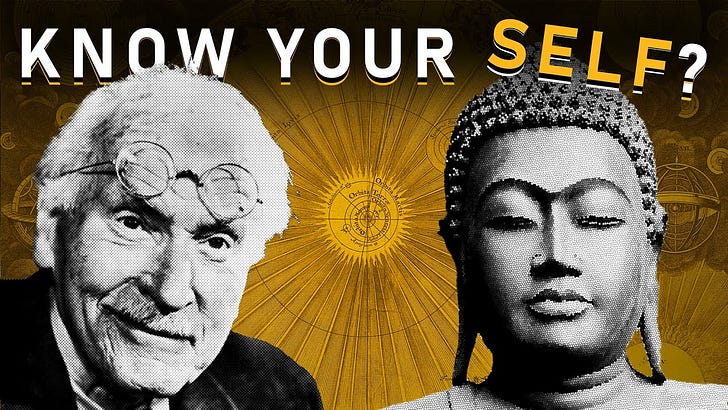
In any case, for Jung, the purpose of human life is to establish and maintain a creative relationship between ego and self. He calls this “individuation” and, borrowing the phrase from Nietzsche, describes it as the process of “becoming yourself”. Jung sees this as the fundamental religious attitude, seeing religion as a state where:
… the life of the individual is not determined solely by the ego and its opinions or by social factors, but quite as much, if not more, by a transcendent authority…an intensely personal, reciprocal relationship between man and an extramundane authority…
C.G. Jung, The Undiscovered Self
Let’s now take this psychological insight and see what new meanings it reveals in the sayings of Jesus.
III. ἐντός
There has been much debate and argument around these two verses from the Gospel of Luke:
Once Jesus was asked by the Pharisees when the kingdom of God was coming, and he answered, “The kingdom of God is not coming with things that can be observed, nor will they say, ‘Look, here it is!’ or ‘There it is!’ For, in fact, the kingdom of God is among you.”
Luke 17:21
The English translators of the Bible have struggled with this immensely. Some render Jesus’ words as “the kingdom of God is among you”, others as “the kingdom of God is in your midst”. Both are viable, but more conscientious editions add a footnote which says the words can also be rendered as “the kingdom of God is within you”, as indeed they are in older translations.
The Ancient Greek word translated here, ἐντός (entós), literally means “inside”. To make his meaning clearer, Jesus explicitly says the kingdom is not something that can be observed here or there, meaning it is not an external thing. You can see how subversive this claim is, given that we are still struggling with it some 2000 years later.
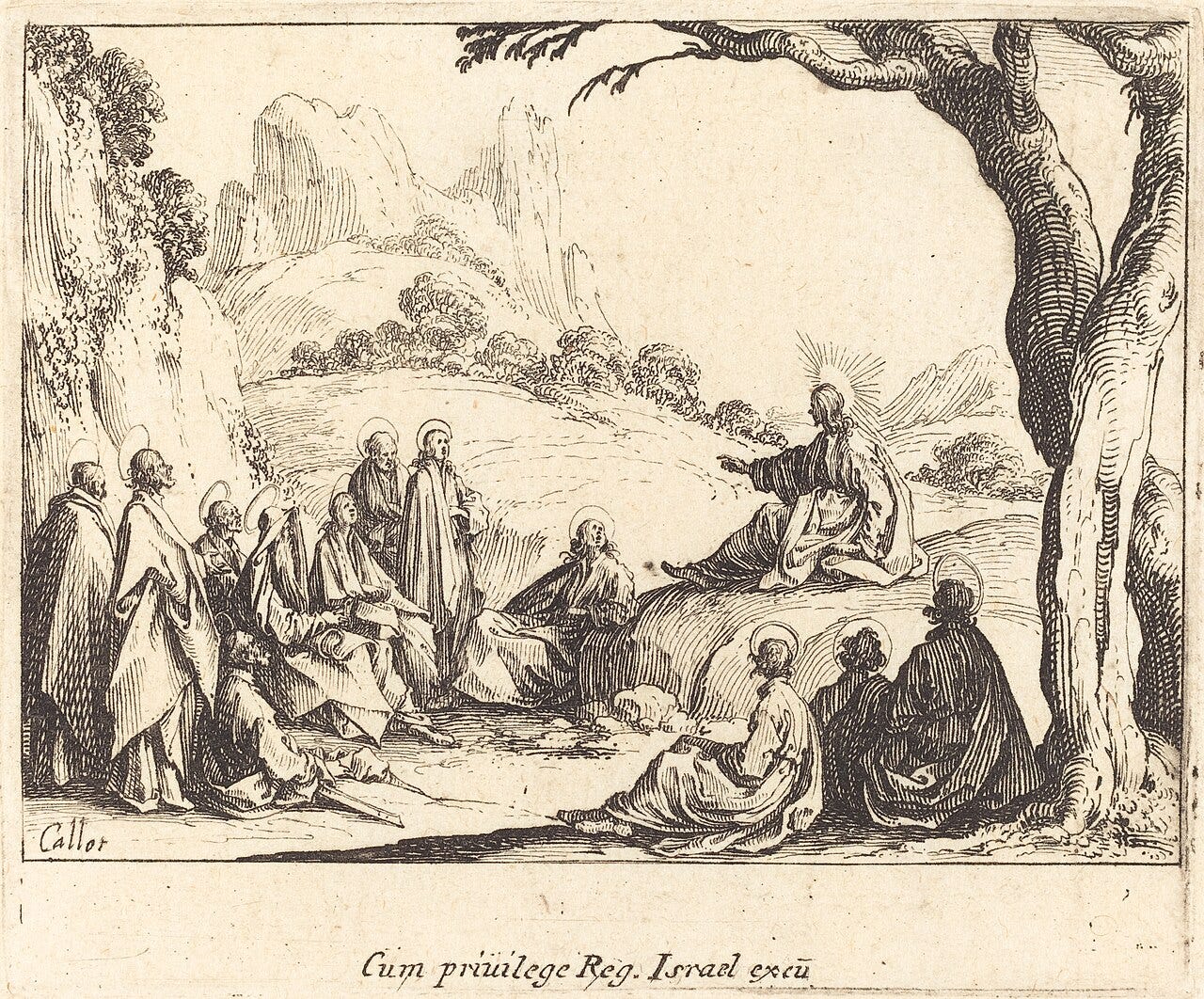
So, what could it mean that the kingdom of God is within us? This may remind us of that strange claim in the Old Testament that human beings have been created in the image of God. It may also remind us of Jung’s insight that the ego–or our surface personality–though being only a fragment of our self, is also the carrier of this self in the world.
If we apply Jung’s model to Jesus’ parables, we may see the ego as he who must discover the kingdom within that is the self. Indeed, that is the true purpose of the ego: it is an imperfect image of the self that must continuously develop to allow more of the self into the world. It must bring the buried treasure out from within.
The problem is, the ego is often its own worst enemy. Its narcissism clogs it up, cutting it off from the self and stifling the growth of the personality. Consider this as we look at the following words of Jesus:
If any wish to come after me, let them deny themselves and take up their cross and follow me.
For those who want to save their life will lose it, and those who lose their life for my sake will find it.
Matthew 16:24-25
In these two lines, Jesus says what takes Jung volumes to elaborate. That is, we must continually sacrifice our small, ego-centred personality if we are to keep uncovering our true individuality.
On the level of the ego, or who we think we are, this feels like death, like a loss of identity. This is why change and growth can be so difficult. Letting go of the person we’ve been so far, and of life as we’ve lived it, can be frightening, painful, and a loss… And yet this loss of who we are is what it takes to uncover more of who we could be.
Jesus is clearly saying that to follow him to the kingdom requires the sacrifice–nay, death–of who we are, and that whoever is unwilling to bear this sacrifice cannot receive the new kind of life that results from it. Or, as he says:
[N]o one can see the kingdom of God without being born anew.
John 3:3
I don’t think Jesus is speaking only psychologically here. It would be wrong to reduce his words to Jung’s theory or to anyone else’s. But we may recognize that it is central to his teaching that we must grow as individuals through continual self-sacrifice. This growth has a paradoxical quality, as it is the greatest gain and yet comes only through loss. It requires sacrificing yourself of your own free will, and yet it leads to truly becoming yourself.
But the ego is not the only obstacle we face in our quest for the kingdom. There is another force continually opposing the growth of individuals.
IV. THE EASY ROAD
Let’s now look at another powerful image Jesus uses. He says:
Enter through the narrow gate, for the gate is wide and the road is easy that leads to destruction, and there are many who take it.
For the gate is narrow and the road is hard that leads to life, and there are few who find it.
Matthew 7:13-14
To get to the kingdom, it is not enough to relinquish our egoic interests. We must also depart from the easy road taken by the many. We must depart from the collective, leaving its security behind to embark on the solitary and difficult journey of self-understanding. Jung, too, has noted the necessity of this. He writes:
[T]he development of personality … is the conscious and unavoidable segregation of the single individual from the undifferentiated and unconscious herd.
C.G. Jung, The Development of Personality
We can never attain an individual–and thus, authentic–attitude to life if we live according to the values and opinions of others. Whether it is our family, friends, coworkers, country, or church–it doesn’t matter. The more reliant we are on a group, the less we have to come up with our own answers to life’s challenges. We receive our ideas about right and wrong, about what is valuable and what is meaningful, from outside. Our life then is only vicarious, an echo of the collective. We are like the man possessed by a legion of spirits, only we are possessed by the thoughts of those around us.
Even living according to Christian values is against the teachings of Jesus if we have not arrived at these values through authentic conviction. Jesus says:
[U]nless your righteousness exceeds that of the scribes and Pharisees, you will never enter the kingdom of heaven.
Matthew 5:20
The scribes and Pharisees, during the time of Jesus, were those most responsible for preserving the values of the Jewish community. He is not criticising the values themselves, as he clarifies:
Do not think that I have come to abolish the Law or the Prophets; I have come not to abolish but to fulfill.
Matthew 5:17
Jesus is rather condemning the outer obedience to moral values as a mechanical gesture when it is disconnected from inner experience. In fact, he goes as far as to say to the Pharisees:
[T]ax collectors and the prostitutes are going into the kingdom of God ahead of you.
Matthew 21:31
This proclamation may sound harsh, but in fact, it contains the most loving and life-affirming aspect of the “Good News” Jesus brings.
V. THE GOOD NEWS
The path Jesus is leading us on passes between two abysses–the ego and the collective–each ready to swallow us whole. And the path itself is “hard”, no less perilous than the danger it is leading away from. Finding our authentic stance on life requires moral experimentation that can easily turn us into villains. And the impulse to be free of our ego can easily degenerate into self-repression dressed as virtue. Whether we take the hard road or not, our souls are always in mortal danger. The only difference is the path Jesus takes us on offers the possibility of salvation.
Unfortunately, most, if not all, of us cannot find this path most of the time. It is not our fault, really… It is just that we are facing near-impossible odds in a world of confusion, apathy, and suffering. But here comes the good news. The one insight I would most like to leave with you.
Let’s read that reproach to the Pharisees again; this time, with a bit more context. Jesus addresses them:
“What do you think? A man had two sons; he went to the first and said, ‘Son, go and work in the vineyard today.’ He answered, ‘I will not,’ but later he changed his mind and went. The father went to the second and said the same, and he answered, ‘I go, sir,’ but he did not go. Which of the two did the will of his father?”
They said, “The first.”
Jesus said to them, “Truly I tell you, the tax collectors and the prostitutes are going into the kingdom of God ahead of you.”
Matthew 21:28-31
It is better to lose your way, Jesus is saying, better to deny God outright, if that is what it takes to one day “change your mind”, than it is to live with outer obedience but no inner conviction. In fact, Jesus goes so far as to say that those who lose their way only to find it again are of greater value to the kingdom than those who have never gotten lost in the first place:
Which one of you, having a hundred sheep and losing one of them, does not leave the ninety-nine in the wilderness and go after the one that is lost until he finds it?
…
Just so, I tell you, there will be more joy in heaven over one sinner who repents than over ninety-nine righteous persons who need no repentance.
Luke 15:4,7
Now this is really good news, for the fact is, each one of us is that lost sheep. This, to me, is what makes Jesus’ message truly universal and timeless. He is not preaching a certain doctrine you have to follow or elaborate rites you have to perform. He also doesn’t care whether you’re a pastor or a prostitute. (The latter, as we’ve seen, can be preferable.) All Jesus cares about is whether you are willing to “change your mind”. This core message has also become the victim of translation, as we’ve come to refer to it with the rather unwelcoming English word “repentance”.
VI. BORN ANEW
The word “repentance” comes with connotations of guilt and self-condemnation, which have sadly become a big part of the popular image of Christianity. In the original Gospels, Jesus uses the word μετάνοια (metanoia), which literally means a transformation of one’s understanding. A change in our way of being so profound that Jesus says:
[N]o one can see the kingdom of God without being born anew.
John 3:3
“Being born anew”, like the caterpillar beginning a second life as a butterfly, is what Jesus is calling us to. This dramatic change is impossible when you are barricaded behind the ego or the collective, hardened with self-righteousness. So this is one part of the message: losing your way is no cause for despair; in fact, it is necessary.
One sure strategy to never discover the kingdom is to remain forever in the bubble of the ego or in the slumber of the collective. This is to remain forever in the womb of your small world, refusing to be born anew and become yourself.
There is another important point. Many Christians may imagine that this transformation Jesus is preaching is a one-off event, like our physical birth. But Jesus is preaching a spiritual kind of birth, a birth “from above”, as he calls it [John 3:3]. He is calling us not so much to the kingdom as a destination, but to the path to the kingdom as a journey.
Whether you hear Jesus’ words for the first or for the millionth time, whether you hear them as a prostitute or as a priest, they are never any less relevant. The butterfly is always needing to be born, in one aspect of our lives or another. This may be one reason why the Gospels refer to the soul by the Ancient Greek word ψυχή (psukhē), which also means “butterfly”. This is the origin of the word “psychology” as well.
As Jung points out, individuation, or becoming ourselves, is a never-ending process of emptying the ego and making more room for the riches of the self. This process makes us less egotistical but more individual, less beholden to social norms, and yet of greater value to the community. It connects us to a higher power that both transcends us and yet lives at our very core. Most importantly, both Jung and Jesus see this as the ultimate purpose and deepest realization of human life. It constitutes not only our discovery of the treasure, but our own transfiguration into treasure, into precious pearls for the kingdom within.
We’ve taken a psychological view of Jesus’ teachings here, which tells us a lot, but not all. For a mystical and no less profound take on how we enter the kingdom, I invite you to my essay on Meister Eckhart’s most famous sermon.
How to Enter Heaven Here & Now
Meister Eckhart points to the fact that our ego and body are not what we truly are. They are rather appearances within what we truly are. They are carried along by the flow of time within the ever-present embrace of aware being.
For a young man you have extraordinary insight, you are truly gifted 🙌