

All that we see or seem
Is but a dream within a dream.
Edgar Allan Poe, A Dream Within A Dream
How real is reality, really? I mean, look around. How much of this world you are perceiving is really “out there” and how much of it is a mental creation, like a dream? You never question the reality of a dream until you wake up, so how are you so certain that what you are experiencing now is not just a different kind of dream? And if it is, what would it mean to wake up from it?
There is a fascinating tradition of Buddhist philosophy built around these questions. This tradition is called Yogācāra, and it is entirely dedicated to the study of mind and reality (or rather, mind as reality). Fifteen centuries before Freud and Jung, Yogācāra discussed the ego, the unconscious, complexes, and projections (using different terms, of course). But their study of the mind goes beyond the bounds of modern psychology, into a non-dual view of reality, where distinctions such as mind and matter, internal and external, observer and observed, no longer hold. Couple this with the Buddha’s teachings on karma, rebirth, and enlightenment, and you can imagine how interesting things get…
Here I will present the deepest and most transformative insights from Yogācāra Buddhism I have discovered, but I should mention one caveat before we begin. Yogācāra philosophy is vast; it has been evolving for centuries, and there are many different interpretations of it. At one end, you can read Yogācāra as saying that all we experience is subjective, coloured by our personal cognitive patterns–a pretty innocuous statement. At the other end, you can interpret Yogācāra as saying that nothing exists apart from consciousness, that the external world, objects, space, and time are only mental constructs. I personally lean towards the latter interpretation, as I do think the Yogācāra arguments inevitably take us there.
Yogācāra philosophy is commonly known as citta-mātra, meaning “mind-only” or “consciousness-only”. Citta-mātra studies the world, objects, our bodies, and all our experiences not as objectively “out there”, but as conscious appearances “in here”, within the mind. Citta-mātra is the result of empirical and rational observations by generations of meditators. So, for all its sophisticated theory, it is grounded in direct experience: in meditation. To immerse us in this experiential kind of exploration, I’ve divided this essay into two parts. Part One is something of a guided meditation, only I’ll do a bit more talking than is usual for a meditation guide. Here, we’ll discover the key Yogācāra insights into consciousness for ourselves by observing our own minds. Part Two is more theoretical and will show us how our meditation insights come together into a non-dual view of reality as the activity of consciousness.
Again, here I’ll lean towards one interpretation of Yogācāra, which you don’t have to agree with to benefit from reading this essay. By the time we are done, you’ll have a subtler and deeper understanding of your mind. You’ll also get an idea of what a non-dual, non-conceptual experience of reality might actually mean. Now, without further ado, I present to you citta-mātra, the Yogācāra view of mind-only.
Part One: The Guided Meditation
[To best experience the following section, you can play the video from this timestamp.]
The Six Sense-Consciousnesses
Let’s explore citta-mātra with a meditation object. Something simple, like this yellow circle. I invite you to rest your eyes on the circle now. Take a few breaths, and settle in. When you’re ready, gently shift your attention from the circle you are looking at to the experience of looking at that circle. What is this experience made of? Let’s peel back its layers one at a time.

First, there is the visual perception of the yellow circle. In Buddhism, this is called the “eye-consciousness”. The Buddha himself analyses consciousness down into separate channels of perception, one for each sense organ. So, there is ear-consciousness, tongue-consciousness, nose-consciousness, and so on. Right now, the yellow circle is a visual impression in your eye-consciousness. So far, so good.
But consider this: how do you know you are looking at a circle right now, and not a triangle, a square, or a squirrel? And how do you know the circle is yellow and not green or blue? “It’s obvious,” you may think… But how is it so obvious?
See, you are not simply perceiving a visual impression at the moment, but also a conceptual interpretation of that impression. This interpretation places the labels “circle”, “yellow”, “looking”, and so on, to translate visual data into a narrative, such as “I am looking at a yellow circle”. In Buddhism, this is called manovijñāna, meaning “mind-consciousness”. The Buddha includes the mind among our sense organs, treating it as that which perceives mental objects, such as thoughts, desires, feelings, and the like. But the mind is also a unique sense organ in that it interprets the information the other sense organs are feeding it.
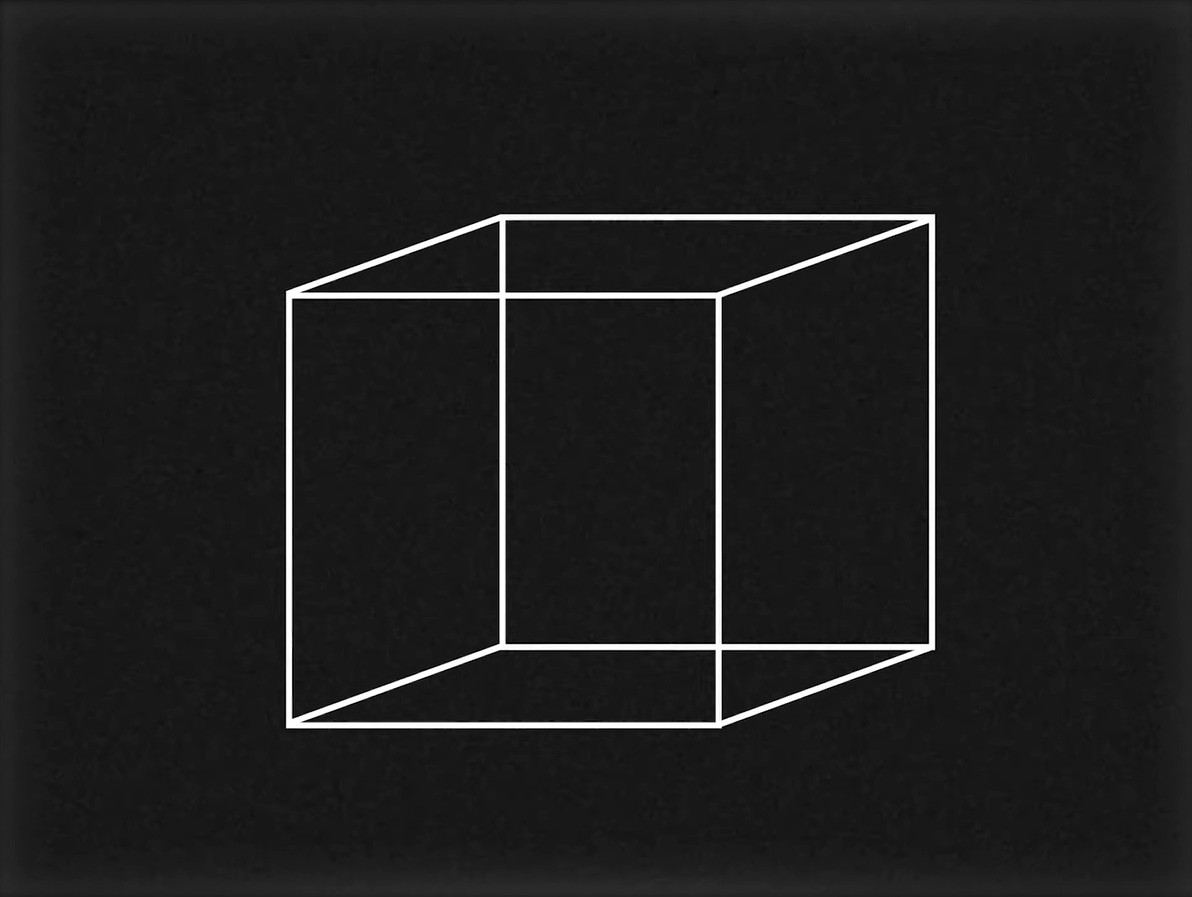
Let me give you an example. If I put these twelve lines on the screen in a particular way, what do you see? You see a cube. The flat image in your eye-consciousness suddenly becomes three-dimensional in your mind-consciousness. Also, you can see the cube facing either up or down, again, depending on the mind’s interpretation. Observe just how much of your seeing is done not through the eyes, but through the mind’s interpretation of what the eyes are seeing. So it is with all the senses: the same smell may repulse you when you think it’s coming from your socks and make you salivate when you think it’s coming from a slice of blue cheese. We mostly don’t experience what we are experiencing, but our thoughts about what we are experiencing.
Now, back to our meditation. We’ve recognised that seeing this circle happens in both your eye-consciousness and your mind-consciousness. Speaking more broadly, we can say experience involves the six channels of consciousness, through which our sense organs feed us information about the world. This model is what the Buddha taught his earliest disciples. But Yogācāra takes things further. Let’s now peel back the next layer of experience…
The Object-Concept
Settle your attention again on the experience of seeing this yellow circle. We will now hone in on a subtle quality present in all conscious experience. Since this quality is always “on”, it is difficult to recognise it as a separate activity of the mind; Buddhist meditators took centuries to notice it, so don’t feel disheartened if it takes you some time as well. I am speaking of viṣaya-vijñapti, meaning “object-concept”.
Think of a dream you remember vividly. In that dream, you encountered people, objects, and places. You experienced these as external and separate from you. You interacted with them as if you were one entity and they another. Only upon waking did you realise all you had been experiencing happened within the mind. While dreaming, you took your own mental creations for real, external objects… How curious! Well, that sense that what you are experiencing is external to you–or objective–is what Yogācāra calls viṣaya-vijñapti, the object-concept.
Now let’s return to our yellow circle. You are not dreaming the circle; it is right here, before your eyes, cognised by your waking mind. But how do you know this circle is an object external to the mind perceiving it? Notice how automatic the assumption is that you are perceiving an external “thing” separate from consciousness. You make the same assumption when you are dreaming, and you never question it then, even though every time you wake up, you know you were only experiencing the activity of your own mind.
Notice the colour of the circle. This colour appears as something external to your mind, something independent from consciousness. Scientifically speaking, we know this is not the case. Colours do not exist outside of our perception. The screen you are reading this text on is emitting electromagnetic radiation with a certain wavelength; the colour yellow is simply how the mind visualises that wavelength. If I shorten the wavelength, you see green, but this green is, again, only a mental representation. As Yogācāra would say, it is citta-mātra, “mind-only”. Still, we see the colour, and we are convinced it is “out there”, in the objective world, not an activity of the mind. This automatic conviction in the objectivity of perceptions is what Yogācāra calls viṣaya-vijñapti.
Great, now let’s peel back the next layer of experience. This will take us to an even subtler activity of the mind, one responsible for most of what we do and most we suffer. The construction of a self.
Manas
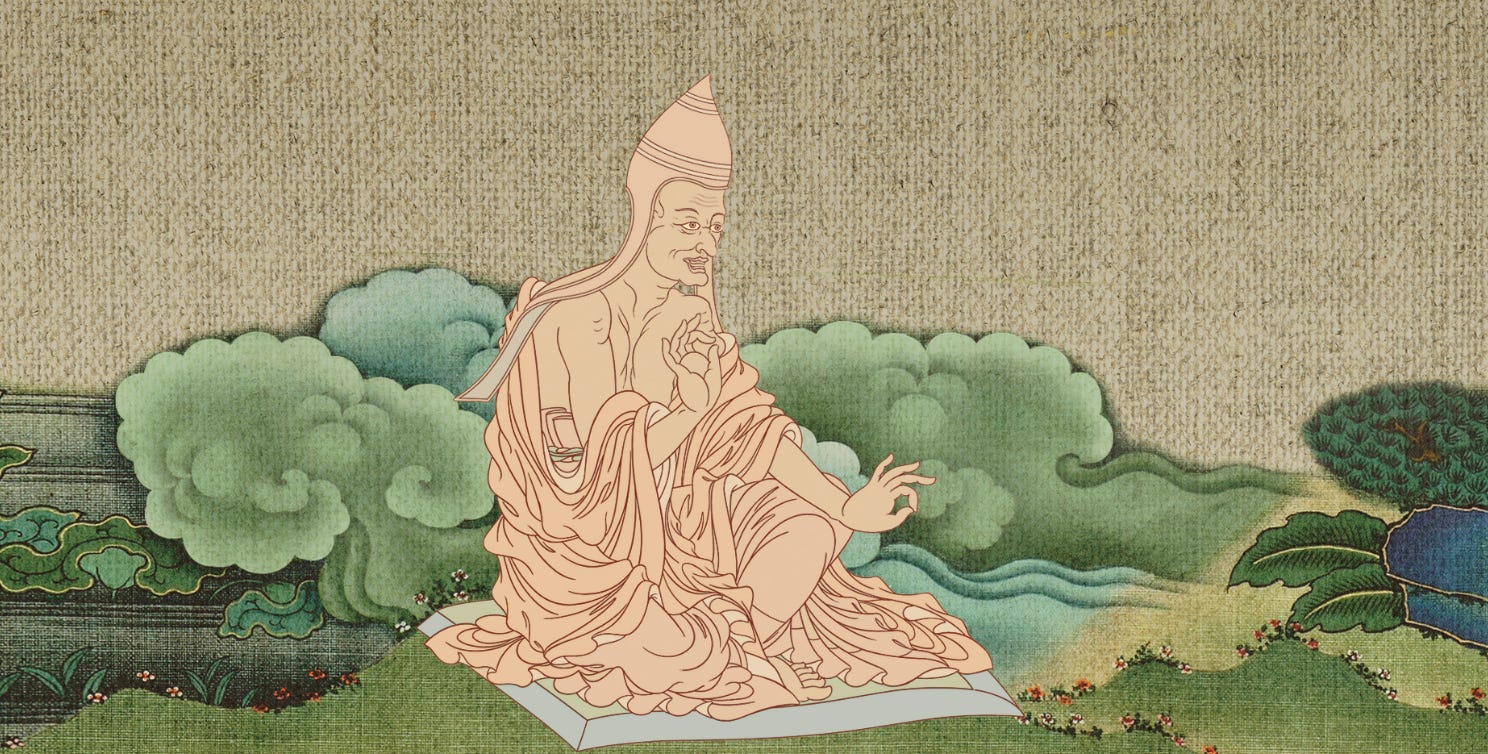
The Buddha’s analysis of the self is probably his most powerful teaching. I explore this in depth in previous essays, which I invite you to read (or watch). Yogācāra, however, again takes things further. It distinguishes a dedicated mental structure that creates and sustains the sense of being a self. They call this function manas (not to be confused with manovijñāna, which is “mind-consciousness”). Let me read you the description of manas in the famous Thirty Verses on Mind-Only by the Yogācāra genius, Vasubandhu:
Its character and nature are that of thought. [Manas] is always associated with the four afflictions, which are delusion of a self, perception of a self, identity with a self, and love of a self, as well as mental contact and the others.
Vasubandhu, Triṃśikā Vijñaptimātratā
This can sound a bit technical, but it is a simple observation. When I say “Look at the yellow circle”, you know it is you I am talking to, you who must look at the circle, and you who sees it. What can be more obvious than the fact that you are the experiencer of experience?
But let’s do a simple experiment. Consider this: do you see your self? I don’t mean your hands or the reflection of your face on the screen, but your self, do you see it? Do you hear your self? And I don’t mean your heartbeat, breath, or other bodily functions, but your self – do you hear it? Or do you smell it? You may smell your perfume, clothes, sweat, or the like, but can you smell your self?
Your physical senses never come into contact with your self or with my self, or with any self for that matter. And yet, the self feels just as real as any physical object. It is a virtual entity the mind inserts into experience automatically – that is to say, unconsciously. Otherwise, we would all be able to drop our sense of self at will, and the Buddha would not have had to teach us how to do so.

As we’ve explored in previous essays, the sense of being a separate self has many evolutionary benefits. Indeed, if somebody lacks a stable sense of identity, this is usually pathological and requires treatment. The point of Buddhist practice and philosophy is not to abolish the self, but to see it for what it is. To see that the self is not the thinker of thoughts, but just a very persistent thought; not the one who is conscious, but an appearance within consciousness.
A few minutes ago, we explored how the mind applies the object-concept to experiences, interpreting them as external. Well, we can say that through manas, the mind also applies the subject-concept (or self) to counterbalance external experiences with an internal experiencer. Yogācāra calls this our “dualistic grasping”. This is the mind’s bifurcation into one part that is internal and experiencing, and another part that is external and being experienced. The line dividing experience into these two aspects, the external and the internal, or the subjective and the objective, exists within the mind only.

This is not a mystical or speculative claim. Observe your present experience. As you are reading this text, viṣaya-vijñapti is the conviction that the text is external to the mind, and manas sustains the sense of being the one inside the mind, reading this text. But both this text and the sense of being the one reading it are appearances within the mind; otherwise, you would not be conscious of them. These appearances do not, by themselves, belong within or without, to the self or not to the self. It is the mind that processes this field of thoughts and sense impressions into a binary picture.
We’re nearly done now with our meditation. We have only one final layer of experience to explore, and this is the greatest discovery the Yogācāra made. Something Freud thought he discovered a millennium later.
Ālayavijñāna
Consider what we’ve explored so far. Consider how you automatically see the yellow circle. Consider how you automatically recognise it as a circle in your mind. Consider how you automatically perceive the circle as external to your mind. And finally, consider how you automatically experience being the one who is seeing the circle. “Automatically” here is to say unconsciously. All this mental activity is somehow orchestrated without any conscious work. This begs the question: What is the origin of the mind’s activity?
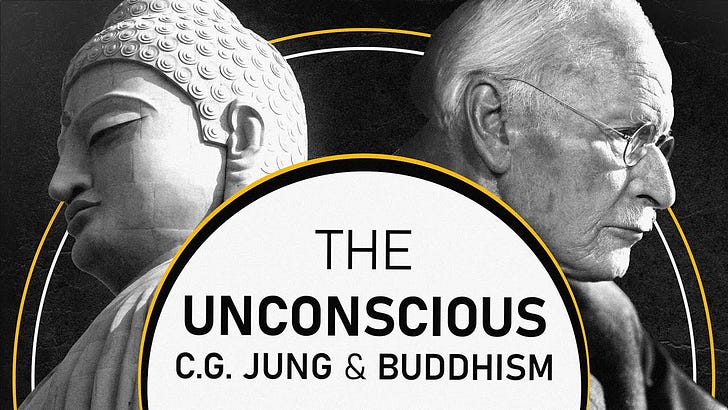
Here, we arrive at the most famous Yogācāra term, the ālayavijñāna. Ālayavijñāna literally means “storehouse-consciousness”. It designates the deepest region of the mind, the origin and support of all conscious experience. In an earlier essay, I compared the ālayavijñāna with Carl Jung’s understanding of the “unconscious”. The similarities are fascinating, so I invite you to check out that video essay to learn more.
Yogācāra sees the storehouse-consciousness as a subliminal, ever-present stream of mental impressions. Whether we are awake, asleep, in deep meditation, or in a coma, the ālayavijñāna is always on, always absorbing experiences and storing them up as impressions. This store then serves as the material out of which future experiences arise.
Before getting too abstract with this, let’s explore it with a simple practice. Please close your eyes for a minute and listen to this sound.
Listen closely. Soak your attention with the sound, and see if anything emerges in consciousness. The mind may respond to the sound by bringing up images, thoughts, memories, feelings… It’s quite magical, really. Now, where did all this new content of consciousness come from? It wasn’t here a minute ago… And where will these impressions go once the sound fades and you focus on something else? You can open your eyes now.
The Yogācārins use a beautiful simile to explain this. They compare sense impressions with seeds and the storehouse-consciousness with the soil, where these seeds are stored. For example, taking a stroll along the beach plants seeds of sensory impressions in your ālayavijñāna. Once you leave the beach, you move on to other things. On the surface of the mind, the experience is gone, just like how you don’t see the seeds buried in the ground during winter. But one day, you hear the sound of waves breaking on the shore. Suddenly, you’re back on the beach; you can almost feel the cool water lapping at your feet, the salty wind, and the laughter of seagulls overhead. Like seeds sprouting in spring, past sense impressions burst out of the storehouse-consciousness. As Yogācāra says, they become reactualised.
But the ālayavijñāna doesn’t only store sense impressions. Much more importantly, it stores habit energy. Every intentional action leaves an imprint on the storehouse of the mind, creating the potential for a similar action or experience in the future. This is most obvious when we think about our habits, especially our bad ones. There, we can see how repetition ingrains certain patterns of behaviour in our being, sometimes so deeply that even conscious effort can’t break the vicious cycle. To extend the Yogācāra metaphor, you can’t plant peaches and expect apple trees.
We are done now with our guided meditation. Observing our experience, we discovered all the major elements of consciousness Yogācāra described: the six sense consciousnesses, the object-concept, manas, and the storehouse-consciousness. Now it’s time to go the other way. Let’s take what we’ve learned about consciousness and see how it comes together to produce the reality we think we are experiencing.
Part Two: The Theory of Mind-Only
The 3 Transformations
How does reality arise in the mind? Let’s begin with ignorance, even though there is no real beginning. The prima causa of this spectacle we call reality is the mind’s ignorance of itself: mind not recognising mind. With this ignorance as a condition, the mind carries out a series of automatic operations known as the Three Transformations of Consciousness. These operations arise simultaneously, but Yogācāra lists them starting with the most fundamental.
First Transformation: Ālayavijñāna
Ālayavijñāna, or the storehouse-consciousness, is the First Transformation of Consciousness. Here, mind manifests as a flow of impressions called vāsanās. These impressions include images, ideas, sensations, and so on, but most importantly, they include acts of volition. All these are the latent seeds that later flower into conscious experiences. The ālayavijñāna is not an entity, not a self, not a soul, but a flow of momentary impressions. It is not found within space or time, as space and time are impressions within it.
This can all sound very abstract, but it refers to our daily reality. For example, let’s do a quick body scan. See if you can hone in on any bodily sensation that you haven’t been paying attention to while reading this text. The sensation can be an itch, some extra pressure, discomfort, pain, pleasure… Whatever you discover, notice how you just became conscious of the sensation, even though it’s been there for a while. And once you shift your attention away from it again, you are no longer conscious of it, and yet it’s still there. But… still where? In the ālayavijñāna. The ālayavijñāna is that great expanse of impressions in which consciousness acts like a tiny mirror. A mirror shifting restlessly from one appearance to another, capturing fleeting images of the storehouse and trying to hold on to them. This takes us to the next step of how the mind constructs reality.
Second Transformation: Manas
Manas is the Second Transformation of Consciousness. Here, the mind acts as a mirror to itself. We can compare manas with the myth of Narcissus, where the boy sees his reflection in a pool, mistakes it for the face of a stranger, and starts clinging to it. Manas captures a subliminal impression from the ālayavijñāna like how a mirror captures an image and reflects it. But more importantly, manas reflects not only the content of the ālayavijñāna, but the ālayavijñāna itself. Of course, the ālayavijñāna is not an entity separate from its content, but it does appear as such in the reifying mirror of manas. So, if you’re wondering what the ālayavijñāna looks like, the best image the mind can have of it is simply your self. You are the reflection of the ālayavijñāna in the tiny mirror of manas.

Let’s return to our body scan. When you locate that bodily sensation, this is manas reflecting an impression within the ālayavijñāna. But your experience is not simply that of a bodily sensation, but of your bodily sensation. That itch is palpably your itch. When manas reflects an impression, it also reflects the space within which this impression arises, meaning the ālayavijñāna. The reflection of this space for mental appearances becomes the image to which manas clings as a self.
But manas does more than simply reflect the ālayavijñāna. It obsesses over its reflection. Manas literally means “thought” or “thinking”. Yogācāra has chosen this name to highlight the constant mental activity here aimed at reinforcing that sense of self. You don’t just cognise the itch as your itch; you also think, “Why do I have this itch?”, “Should I scratch this itch?”, “Maybe I should practice non-scratching.”, “But maybe I shouldn’t repress my desire for scratching...” Thus, manas immediately obscures direct experience with countless narratives, thoughts, and emotions concerning the imagined self…
Third Transformation: Viṣaya-Vijñapti (via the Six Sense-Consciousnesses)
To complete the picture of reality as we know it, the mind performs the Third Transformation of Consciousness. Here, mind takes the form of our six sense-consciousnesses as coloured by viṣaya-vijñapti, or the object-concept. So, once the mirror of manas reflects that bodily sensation within the ālayavijñāna, viṣaya-vijñapti (via the six sense consciousnesses) adds the icing on the cake, the conviction that your bodily sensation is something objectively “out there”, something perceived by the mind, not an activity of the mind. Consider the fact that over 80% of people with amputation still feel sensations in their missing limbs. This goes to show just how much the object-concept shapes our experience of the world–even when the object is obviously not there.
These, then, are the Three Transformations of Consciousness: the ālayavijñāna, manas, and viṣaya-vijñapti via the six sense consciousnesses. Their simultaneous activity arises due to the mind’s ignorance of its own nature. It creates the illusion of an external reality and an internal self experiencing that reality. This illusion, in turn, further confuses the mind, prevents self-realisation, and feeds the cyclical arising of experience we call birth, death, and rebirth. As one scholar puts it:
We are enwrapped like the silkworm in the cocoon [spun] by our own selves and transmigrate from one form of existence to another, from one world to another forever.
Chhote Lal Tripathi, The Nature of “Reality” in Yogācāra Buddhism
So this is how the mind creates the appearance of an external reality according to Yogācāra. Clearly, this view opens up at least as many questions as it seeks to answer. Let’s look at a few really important ones.
First, if reality is just a mental creation, how does the mind choose what experience to have? Why would we experience so much hardship and sorrow if the mind has the power to experience whatever it can imagine?
Second, what about our shared perceptions? If you share this essay with a friend (which I would appreciate), you will both be reading the same text. Doesn’t this prove that this text is an external object, independent of both of your minds?
And finally, what’s the point of all this theorising about the nature of mind and reality? The Buddha’s aim was always liberation from suffering, not philosophical diversion. Does the Yogācāra view of citta-mātra have any utility in helping us out of our everyday ignorance and suffering?
Consciousness & Karma
There is an important element of citta-mātra I haven’t mentioned. Now that we know about the Three Transformations of Consciousness, it is time we look at the force behind them, the law that directs the mind’s generation of experience. It’s time we talk about karma.
In the earliest sutras, the Buddha says:
Karma is what creates distinctions among beings…
Cula-Kammavibhanga Sutta, MN 135
He also says:
The [body-mind] is to be regarded as old karma, brought into existence and created by intention…
Kamma Sutta, SN 35.145
I have an in-depth essay about karma and rebirth. I invite you to read/watch that to see just how profound and elegant this teaching of the Buddha is. Here, I’ll only briefly mention the aspects most relevant to Yogācāra.
The Buddha teaches that all experience is the result of karma. Your karma includes all your intentional thoughts, words, and actions in this life, and in an infinite series of past lives. Everything you experience in life, the Buddha says, down to the most trivial detail, even down to reading this text, is literally what your past karma looks like. Your life is your karma objectified. For example, if you’ve spent years reacting to stress with anger, you’ll tend to find yourself in situations full of conflict and tension. If you’ve spent years practicing patience and kindness, you’ll tend to find yourself surrounded by more trust and goodwill. Different seeds, different “worlds.” Now, Yogācāra elaborates on this teaching with a profound psychological twist. To my understanding, Yogācāra says consciousness and karma are all you need to explain reality. Let me explain…
First, Yogācāra notes that the ālayavijñāna is what makes karma and rebirth possible. Only an unconscious storehouse of past experiences can explain how something you did a decade ago shapes your experience today. The intentional action of hurting or helping somebody leaves an impression in the ālayavijñāna, where it becomes the seed of a future experience. When the right conditions appear, that impression (or vāsanā) becomes reactualised, and you experience being hurt or helped by somebody. To give an extremely simplified example, if you punch the wall in a fit of anger today, your hand will hurt tomorrow. The Buddha has taught in detail how there is no self who punches the wall today, and there is no self whose hand is hurting tomorrow. But there is the punch, and there is the hurt. Yogācāra adds that it is the ālayavijñāna that provides the continuity between the two. The punch plants a seed in the ālayavijñāna, and that seed flowers into hurt. In the same way, the ālayavijñāna connects all moments of cognition in this life and across lives.
So, the ālayavijñāna allows karma to work. Karma, in turn, determines what experience the mind will form at any given moment. This text is how your past intentional actions appear to your eyes and mind at this moment. In turn, your choice to read this text (and thanks for that, by the way) informs what future experiences your mind will generate. The mind doesn’t choose what to experience; it simply responds to past karma and to the present causes and conditions. It is like the ocean, which doesn’t choose when to ebb and when to flow, but simply responds to the law of gravity and the movement of Earth, Moon, and Sun.
The Yogācārins say karma is also the reason why different beings seem to perceive the same external objects. For example, Elly, my fiancé, has a pair of red socks. When she looks at her red socks and when I look at the red socks, we both see the same thing: a pair of red socks. A Yogācārin would say Elly and I have a lot of shared karma, hence our similar body-minds, hence we both perceive a pair of red socks. Now Barney, our dog, has a different kind of body-mind, the result of different past karma. When Barney sees the red socks, I don’t know what he sees, but he goes crazy, he starts biting, licking, and tossing them around. Obviously, he is experiencing a very different kind of object.

Such differences in perceived reality exist between people, too. For example, this essay will seem fascinating to one reader, boring to another, and to another it will be blasphemy against the one true religion. Now, which is it? Is the essay fascinating, is it boring, or is it blasphemous? “That depends on your past karma,” Yogācāra would answer. In reality, there are no two people who will read the exact same text when they see this. For Barney, I doubt this essay even appears as an object in consciousness.
Still, to me, to you, and to pretty much every reader, this text is, well, a text. For Yogācāra, this is not an argument for the objective existence of this text outside our minds. It is simply a consequence of our shared karma. You and I, and pretty much every reader of this text, for all our differences, we are all human beings. This means we are experiencing many shared karmic patterns, which our limited human language represents as objects and events in a shared “external” world. In fact, says Yogācāra, we are each trapped in our own private mental simulation of reality. The question then is, how do we exit the simulation? How do we experience reality beyond mental constructs? How do we wake up?
Awakening
After all their sophisticated analysis, the Yogācārins end up back with the Buddha’s fundamental insight. Ignorance of the mind’s workings leads to craving and aversion for objects that are only as real as a dream. These craving and aversion lead to misguided intentional actions (or karma), which then fuel the vicious cycle of becoming, where ignorance and suffering propagate from one lifetime to another. You can compare this with the Buddha’s teaching of Dependent Origination, his most profound doctrine, which I explore at length in a previous essay.
In any case, to end the vicious cycle of suffering, one must end its root cause, which is ignorance; more specifically, ignorance of how your mind functions. So, how do we end ignorance? In short, first we learn citta-mātra—then we unlearn citta-mātra.
In his Thirty Verses on Mind-Only, Vasubandhu writes:
So long as one has not given rise to the mind which seeks to abide in the nature of mind-only, then regarding the two types of grasping dispositions, he is still not yet able to subdue and extinguish them.
Vasubandhu, Triṃśikā Vijñaptimātratā
In other words, so long as you have not started investigating the backstage of the mind, where experience is constructed, you remain caught in dualistic grasping to subject-and-object, self-and-other, internal-and-external. You are not experiencing reality, but your own private karmic dream. Noticing you are dreaming is the first crucial step. Still, it does not constitute waking up. Vasubandhu continues:
Setting up and establishing even something small and saying this is the nature of mind-only, because there is still something which is grasped, it is not truly abiding in Consciousness Only.
Vasubandhu, Triṃśikā Vijñaptimātratā
This is a profound and subtle warning. You see, waking up is not a matter of thinking about reality in a new way. If we return to our meditation object, the yellow circle, we may now see it as a creation of the Three Transformations of Consciousness. We’ve learned some new terminology, but are we any nearer to awakening? Have we not only substituted one concept with another? To go beyond the mind’s creations, we clearly need an approach other than conceptual thinking. Let me read you how Vasubandhu concludes his Thirty Verses:
Without grasping and not conceptualizing—this is the wisdom of the supramundane realm which abandons the coarseness of duality and naturally attains transformation of the basis.
This itself is the realm of no outflows, inconceivable, good, and eternal, the peaceful and blissful body of liberation, and what the [Buddha] called the Dharma.
Vasubandhu, Triṃśikā Vijñaptimātratā
This is the Yogācāra view of final awakening. The “transformation of the basis” occurs when ordinary consciousness (or vijñāna) becomes direct knowing (or jñāna). This is pure experiencing, devoid of subject-object duality, devoid of conceptual interpretation. We get a taste of this when we’re absorbed in music, or watching a sunset, and for a moment there’s just the colour and just the sound, no commentator in the background saying, “I like this” or “I should take a photo.” Just experiencing.
This may seem like a unique conclusion of the citta-mātra doctrine, but it is only a reformulation of the Buddha’s original teachings. When Bāhiya, a sage who was soon to die, asked the Buddha for a concise summary of the Dharma, the Buddha told him:
When for you there will be … only the sensed in reference to the sensed, only the cognised in reference to the cognised, then, Bāhiya, there is no you in connection with that. When there is no you in connection with that, there is no you there. When there is no you there, you are neither here nor yonder nor between the two.
This, just this, is the end of suffering.
Bāhiya Sutta; Ud 1.10
What the Buddha describes to Bāhiya is just that non-dual awareness that Yogācāra calls jñāna. Jñāna designates direct knowing, raw immediacy prior to the mind’s conceptual processing. The experiencing of suchness.
As we see, this conclusion of Yogācāra teaching does not belong to Yogācāra, but neither does it belong to the Buddha. I see it as a universal insight of non-dual traditions. For me, the person who communicates it most clearly is a modern sage who belongs to no tradition, Jiddu Krishnamurti. He says:
In the state of experiencing, there is neither the experiencer nor the experienced. The tree, the dog and the evening star are not to be experienced by the experiencer; they are the very movement of experiencing. There is no gap between the observer and the observed… Thought is utterly absent, but there is being.
Jiddu Krishnamurti, Commentaries on Living Series 1
You can taste this in small ways. After reading this essay, when you’re washing a dish or walking to the next room, see if there can be only the sensation of water on your hands, only the sound of your footsteps, letting your train of thought dissolve into presence. That tiny shift is already a kind of awakening.
The Yogācārins, of course, being the hyper-analytic psychologists they are, have a technical vocabulary surrounding awakening. We could go into that, but I think it would defeat the purpose of what we’ve been talking about. After all, how many more mental models do we need before we are ready to experience reality beyond mental models?
I hope this essay has given you some new perspective on the workings of your mind and the nature of what you experience as an external reality. Please don’t take what I’ve presented here as a definitive introduction to Yogācāra, but as one possible reading. Citta-mātra is a profound and subtle view of reality, which even a lifetime of study cannot exhaust.
The question remains, how are we to actualise this non-conceptual mode of experiencing the Yogācārins call jñāna? How can we perceive reality beyond the constructs of the mind? Here, I would rather leave Yogācāra territory and direct you to the most lucid nondual teacher I know of, Krishnamurti. Coming into contact with his teachings has had a lasting impact on my mode of being in the world, and I present his insights in another essay. If you’d like to explore this non-conceptual way of living in more practical detail, I recommend reading/watching that next.
Thank you for reading, and remember: “What you seek is seeking you.”

.jpg)

Simeon, thank you so much for this.
I bookmarked your video when it came out, but I knew I wanted to read it as an essay first.
Your videos, to me, belong in a museum. A dense collage of ideas and images, like something Jean-Luc Godard would make. It’s low-key miraculous that we can watch them on YouTube.
When it comes to dense ideas, I need to read slowly, taking notes. That was super helpful in this case, as my prior exposure to Vasubandhu has been confusing. I encountered him through the writing + talks of Jay Garfield and the book “Inside Vasubandhu's Yogacara: A Practitioner's Guide” by Ben Connelly — both excellent, but this piece contributes something new to my understanding.
Sorry for glazing you so much, but you’re kind of a triple threat — simultaneously a deeply skilled practitioner, writer, *and* filmmaker. It’s a treat to encounter you across so many media — video essays, essays, and now interviews. Each unveils a different facet.
Keep up the good work.
Very nicely done and greatly appreciated. This is considered a difficult topic in Western thought, and this presentation is clear and straightforward! Thank you, Simeon.
--
The Lankavatara Sutra is considered by many to be of the Yogacara tradition. Here is an outline of it: https://burnteliot.substack.com/s/lankavatara