

_-_Christ_and_the_Woman_Taken_in_Adultery_-_Academia_Carrara.jpg)
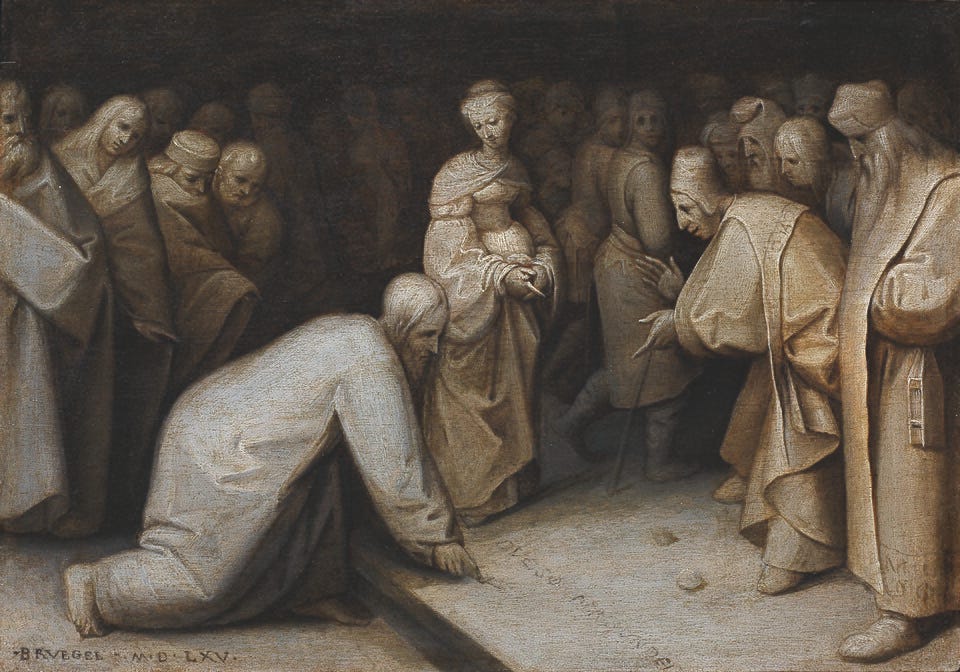
“He that is without sin among you, let him first cast a stone,” said the Sinless One and cast no stone (John 8:7).
What is a “good person”? It is an ideal, and like all ideals, it is a form of protection against reality. The degree to which I know myself as a “good person” is the degree to which I do not know myself as a person. And in the shadow cast by my ideal, its opposite grows and festers with all the violent energy of reality denied.
The ideal of the “good person” is conditional and exclusive. It circumscribes what portion of reality agrees with it and damns the rest to hell, fracturing life by casting stones of “right” and “wrong”. The ideal is the enemy of love—love being that which makes whole and includes, that to which conditions bend their knee. The ideal of the “good person” is born of fear, and like all progeny of fear, it breathes life into that which it opposes.
“I’d rather be whole than good,” said Jung, which is what one says when they drop their stone uncast. With the stone goes our protection, and the fear, now exposed, makes its plea: “But what about morality? What about justice? What’s there to live for if we drop the Good, the True, and the Beautiful?”
What’s left to live for is life itself, but this no ideal comprehends; ideals are all partial, while life is always whole.
May we line the Earth with stones uncast,
Simeon
“That which is done out of love is always beyond good and evil.”
—Friedrich Nietzsche
Suggested Reading

The Sovereignty of Good by Iris Murdoch
Iris Murdoch invites us to drop the armor of moral identity and learn to look at the world with just, loving eyes. Here, goodness ceases to be a form of judging and becomes a way of seeing.
Order here to support SEEKER TO SEEKER at no extra cost. You can also browse my personal list of life-changing books here.
Christ & Buddha – Love vs Detachment
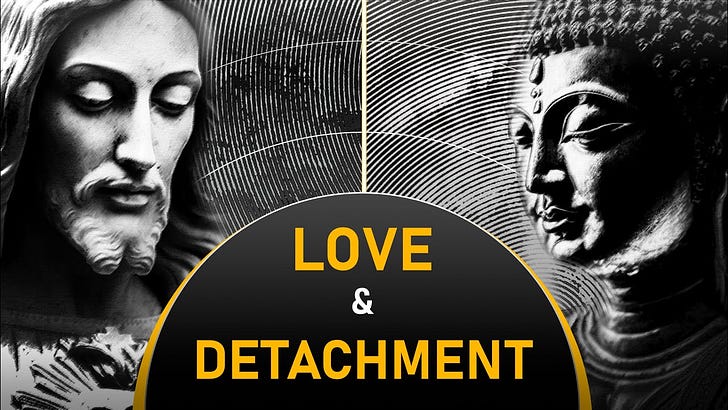
The Buddha leads us to detachment – Christ leads us to love. Are these two teachings in conflict? If not, how could we reconcile such opposites? What do love and detachment even mean?